
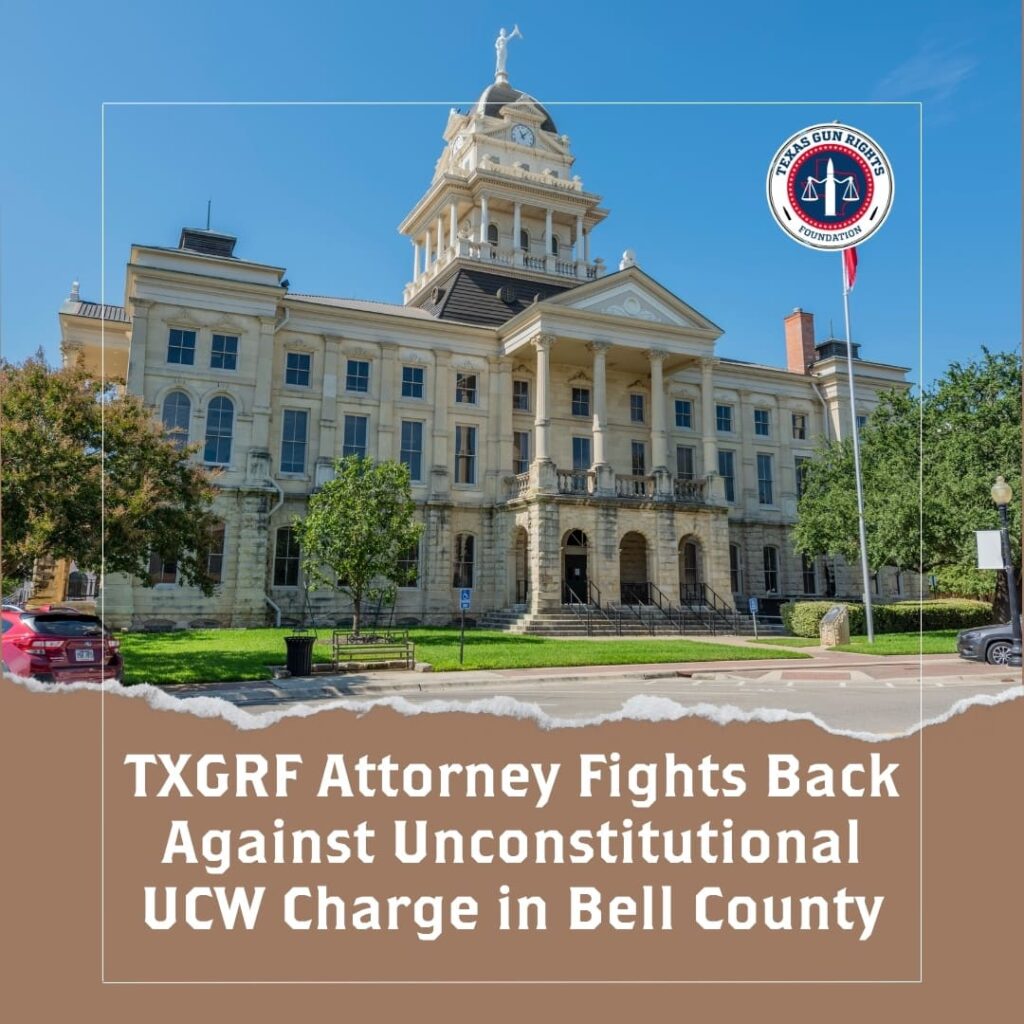
Texas Gun Rights Foundation attorney CJ Grisham is fighting back against a Bell County prosecution that should alarm every gun owner in Texas.
The case involves Stephen Hernandez, a member of the Mongols Motorcycle Club, who was stopped by Killeen Police Department “Gang” officers while riding his motorcycle.
According to the motion filed by Grisham, officers claimed the stop began over an alleged license plate issue — a Class C traffic offense.
But what happened next is where this case turns from a traffic stop into a constitutional fight.
Officers discovered two lawfully possessed pistols secured inside closed saddle bags and compartments on Hernandez’s motorcycle.
The firearms were not brandished.
Not displayed.
Not used.
Not threatened.
Not alleged to have played any role in the stop.
Yet prosecutors charged Hernandez with Unlawful Carry of a Weapon.
Why?
Because the State is trying to use a separate and disputed “evading” allegation to claim Hernandez was “engaged in criminal activity” while carrying — transforming otherwise lawful possession into a criminal weapons charge.
Grisham is now challenging that UCW charge both as applied to Hernandez and on its face.
This is exactly the kind of fight Texas Gun Rights Foundation was built for.
Lawful Carry Is Not a Crime
Texas is a Constitutional Carry state.
Law-abiding Texans do not need government permission to carry a handgun.
But under the State’s theory in this case, a gun owner can be carrying legally one moment — and then suddenly face a criminal weapons charge the next because prosecutors tack on an unrelated allegation.
The motion argues Texas’ “engaged in criminal activity” provision violates the Second Amendment under the U.S. Supreme Court’s Bruen decision, which requires the government to prove modern gun restrictions are consistent with America’s historical tradition of firearm regulation.
And the government cannot point to a founding-era tradition of turning lawful carry into a crime simply because a person is accused of some unrelated offense.
At the Founding, Americans routinely carried arms while traveling, working, and going about daily life.
There was no historical rule allowing the government to criminalize peaceful firearm possession just because the person carrying was accused of another unrelated offense.
No Threat. No Nexus. No Crime.
The facts alleged in the motion make the UCW charge even more outrageous.
The firearms were secured in compartments.
They did not enable anything.
They did not threaten anyone.
They did not escalate anything.
They were simply present.
According to the motion, the alleged “evading” charge is also sharply disputed. Grisham argues officers did not continuously activate their sirens until Hernandez was only a short distance from where he stopped — and that Hernandez and the other riders pulled over once the sirens became unmistakable.
Yet that disputed evading allegation is now being used to justify an additional weapons charge.
Guilt by Association Is Not Justice
This case also raises serious First Amendment concerns.
Hernandez is a member of the Mongols Motorcycle Club, which law enforcement has labeled an “outlaw motorcycle gang.”
But the Constitution does not allow the government to strip a man of his rights because of who he associates with.
The First Amendment protects freedom of association.
The Second Amendment protects the right to keep and bear arms.
The government cannot combine two lawful facts — club membership and firearm possession — and magically turn them into a crime.
The motion relies heavily on Martin v. State, where the Texas Court of Criminal Appeals made clear that mere membership in a designated organization is not enough to support a UCW conviction.
The State must prove the individual personally and regularly associated in the commission of criminal activity.
A patch on a vest is not probable cause to erase the Bill of Rights.
And lawful gun ownership does not become criminal because the government dislikes who someone rides with.
TXGRF Is Taking Up the UCW Fight
Grisham’s motion asks the court to dismiss the UCW charge and quash the underlying complaint.
If successful, this case could help strike a blow against one of the most dangerous abuses in Texas weapons law: using vague “criminal activity” language to turn lawful carry into a separate prosecution.
That matters for every gun owner in Texas.
Because if the State can criminalize lawful carry based on an unrelated allegation, Constitutional Carry becomes a hollow promise.
If prosecutors can use broad statutory language to punish Texans for firearms that were never used, displayed, or connected to any threat, then every gun owner is vulnerable.
And if law enforcement can use disfavored associations as a shortcut to target gun owners, then both the First and Second Amendments are under attack.
Texas Gun Rights Foundation exists to fight cases exactly like this.
The Second Amendment does not come with a government-approved popularity test.
It does not disappear because of a traffic stop.
And it cannot be reduced to a privilege prosecutors can revoke by piling on charges.
The Constitution means what it says: The right of the people to keep and bear arms shall not be infringed.
Chip in today to help Texas Gun Rights Foundation fund more fights like this and defend law-abiding gun owners from government overreach.