

Everytown for Gun Safety’s latest Texas fact sheet presents a familiar conclusion: Texas suffers from “gun violence” because state lawmakers have not adopted the organization’s preferred gun-control agenda.
But Everytown’s own numbers do not prove that claim.
The underlying mortality data largely comes from government sources and reflects real human suffering. Texas faces serious challenges involving suicide, homicide, domestic violence, and criminal shootings. The question is not whether Texans should care –– it is whether Everytown’s framing accurately explains what its numbers show.
A closer review suggests it does not.
“Gun Violence” Is Not One Problem
Everytown reports that an average of 4,471 Texans die and 7,726 are wounded by firearms each year, giving Texas the nation’s 30th-highest combined rate of firearm death and injury.
But that category is far broader than many readers may realize.
Everytown combines firearm suicides, criminal homicides, shootings by police, accidental shootings, undetermined deaths, nonfatal assaults, suicide attempts, and other firearm-related injuries under the single label “gun violence.”
In Texas, Everytown’s own fact sheet says 58% of firearm deaths are suicides, while 39% are homicides. Police shootings, accidental deaths, and undetermined cases make up the remainder.
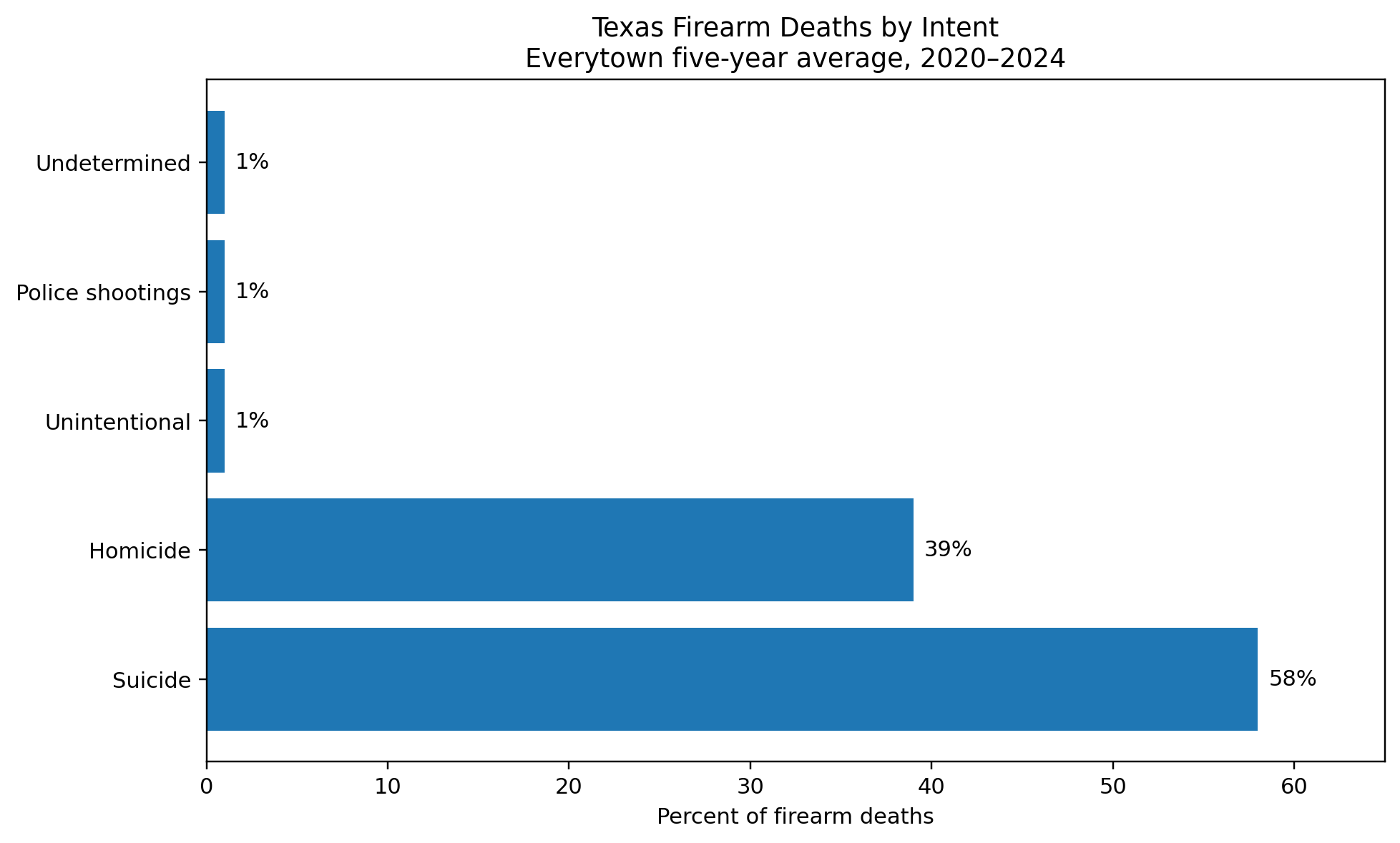
Those categories are not interchangeable. Suicide, criminal violence, lawful police use of force, and accidental injury do not necessarily share the same causes or require the same policy response.
That does not diminish the tragedy of suicide. It means a combined “gun violence” total is not the same thing as a violent-crime statistic — and it does not automatically prove that restrictions on lawful gun ownership would address the deaths being counted.
Texas Is Not Near the Top of Everytown’s Own Rankings
Despite Everytown’s criticism of Texas, its own rankings place the state broadly near the national middle.
According to Everytown’s Texas fact sheet, Texas ranks:
- 30th for overall firearm deaths and injuries;
- 31st for firearm suicides and suicide attempts;
- 23rd for firearm homicides and assaults; and
- 28th for estimated societal cost per resident.
Those are not rankings anyone should celebrate. But they also do not support the claim that Texas is uniquely dangerous because it protects the right to keep and bear arms.
Everytown’s own statistics should create some caution before accepting sweeping claims that Texas gun laws are the obvious cause of the state’s outcomes.
The Biggest Increase Came During a Nationwide Crisis
Everytown emphasizes that Texas’ firearm-death rate increased 18% from 2015 to 2024, while firearm-suicide and firearm-homicide rates each increased 19%.
Those endpoint comparisons are mathematically accurate. But they leave out one of the most important features of the broader trend: the sharpest increase occurred during 2020 and 2021, followed by a gradual decline.
A simple comparison between 2015 and 2024 can make it appear that Texas experienced a steady, policy-driven rise throughout the decade. Everytown’s own graph suggests something more complicated — a major increase during the height of the COVID-era disruption, followed by several years of improvement.
That pattern was not unique to Texas.
Across the country, 2020 and 2021 were marked by a historic rise in homicide, severe social disruption, economic instability, interrupted public services, and widespread civil unrest. Any serious analysis should account for that extraordinary national context.
This does not prove that one event or policy caused the entire increase. It does mean Everytown cannot credibly imply that Texas gun laws explain a nationwide spike while minimizing the most socially disruptive period in recent American history.
The direction of the recent trend also matters. If rates have been declining since the 2021 peak, readers deserve to know that — not merely that the 2024 rate remained above its 2015 level.
Washington Complicates Everytown’s Theory
Everytown frequently treats state gun-law rankings as though they explain state outcomes.
Its own data complicates that theory.
Washington is praised by gun-control advocates and ranked among the states with the strongest gun laws. Yet Everytown’s figures show that Washington’s firearm-homicide rate increased 33% from 2015 to 2024.
Texas experienced a 19% increase over the same period. The nationwide increase was 14%.
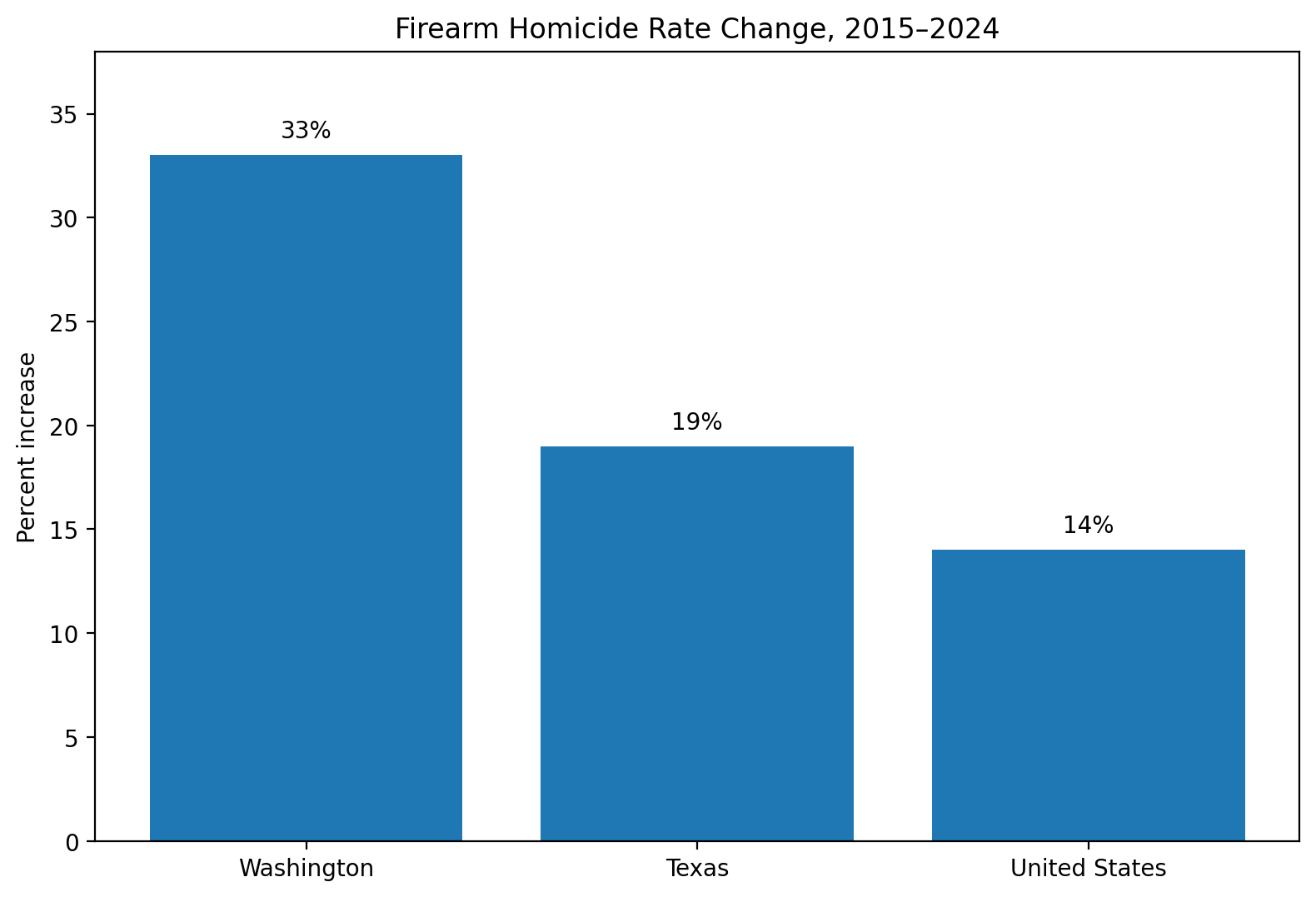
That comparison does not prove Texas policy caused a better result, nor does it establish that Washington’s laws caused its larger increase.
It does show that the relationship between gun laws and homicide is not nearly as simple as Everytown’s rhetoric suggests.
If restrictive gun laws automatically produced better outcomes, Washington should not have experienced a substantially larger increase in firearm homicide than Texas.
A serious analysis would consider criminal activity, policing, prosecution, poverty, urban concentration, repeat offenders, demographic differences, and the unusual disruptions of 2020 and 2021. An ideological policy score cannot explain those variables by itself.
Some of Everytown’s Most Prominent Numbers Are Dated Estimates
Everytown’s Texas fact sheet is presented as updated in 2026, but some of its headline figures rely on older inputs.
Its nonfatal injury estimate is based on 2020 hospital data. Its societal-cost estimate relies on 2019 fatal and nonfatal injury data, combined with economic modeling.
That does not make the estimates meaningless, but it changes how they should be understood.
The “7,726 wounded” figure is not a current 2026 statewide count. The “$51.3 billion annual cost” figure is not a direct Texas budget expenditure. Only a portion is described as a taxpayer cost; the rest consists of modeled social and economic losses.
These estimates may be useful when clearly labeled. They should not be presented in a way that makes them appear to be direct, current-year measurements.
The “Children and Teens” Framing Needs More Context
Everytown says firearms are the leading cause of death among Texas “children and teens,” while separately reporting an annual average for firearm deaths among people ages 0–19.
Those are not identical populations.
The annual figure includes 18- and 19-year-old legal adults, while the “leading cause of death” calculation uses ages 1–19, excluding infants.
That distinction matters because firearm mortality is not evenly distributed across childhood. National research shows the burden rises sharply among older teenagers, while firearms remain well below the leading cause of death for younger children. One recent analysis found firearms became the leading cause of death among ages 14–19, but remained fourth among children ages 0–13.
Among older teenagers, homicide accounts for a substantial share of firearm deaths and is heavily concentrated in particular communities. Federal research recognizes youth gang, group, and community gun violence as distinct problems that are commonly addressed through focused deterrence, gang intervention, and other targeted strategies — not through treating every household and every lawful gun owner as equally responsible.
That does not mean every youth firearm death is gang-related. The broader category also includes suicide, domestic violence, accidental shootings, and other circumstances. But Everytown’s sweeping “children and teens” headline obscures the extent to which the numbers are driven by older adolescents and concentrated forms of violence rather than a uniform risk faced by all Texas children.
Most readers understand “children” to mean minors, especially younger children. A transparent presentation would separate younger children, older minors, and legal adults ages 18 and 19 — and would distinguish homicide, suicide, and accidental deaths within each group.
Statewide Numbers Can Conceal Concentrated Violence
Everytown’s own data shows that firearm homicide is not evenly distributed across Texas.
The burden is concentrated among particular age groups, communities, and neighborhoods. That does not establish the cause of those disparities, and the figures should not be used to stigmatize any population. But it does show why a single statewide rate can be misleading.
Policies aimed broadly at millions of peaceful gun owners may be poorly targeted to violence driven by repeat offenders, gang or group conflicts, domestic abuse, mental-health crises, and localized criminal activity.
A serious response should focus resources where the harm is actually concentrated rather than assuming that statewide restrictions will address every form of firearm death equally.
Broad restrictions should not be presumed effective merely because an advocacy scorecard labels them “strong.”
The Data Deserves Attention. The Framing Deserves Scrutiny.
Texas faces real problems involving suicide, criminal violence, domestic homicide, and preventable firearm injuries.
Those problems deserve honest engagement.
But Everytown’s Texas report does more than present raw data. It combines distinct categories under one advocacy label, relies heavily on a decade comparison shaped by the extraordinary 2020–2021 national crisis, uses dated and modeled estimates as current-looking headline figures, and suggests a stronger causal relationship between gun laws and state outcomes than the evidence establishes.
Public policy should be based on transparent definitions, properly contextualized information, and careful evidence about what specific policies accomplish — not an advocacy scorecard designed to confirm a predetermined conclusion.
Texas Gun Rights Foundation will continue educating the public, examining firearm-related data carefully, and promoting constitutional principles alongside honest, rigorous analysis.
Support Texas Gun Rights Foundation’s legal and educational work to help defend the Second Amendment and advance the constitutional rights of gun owners.