The deadly shooting at Seattle’s largest food festival is already being reduced to another example of “gun violence.”
But the facts point to a much different lesson.
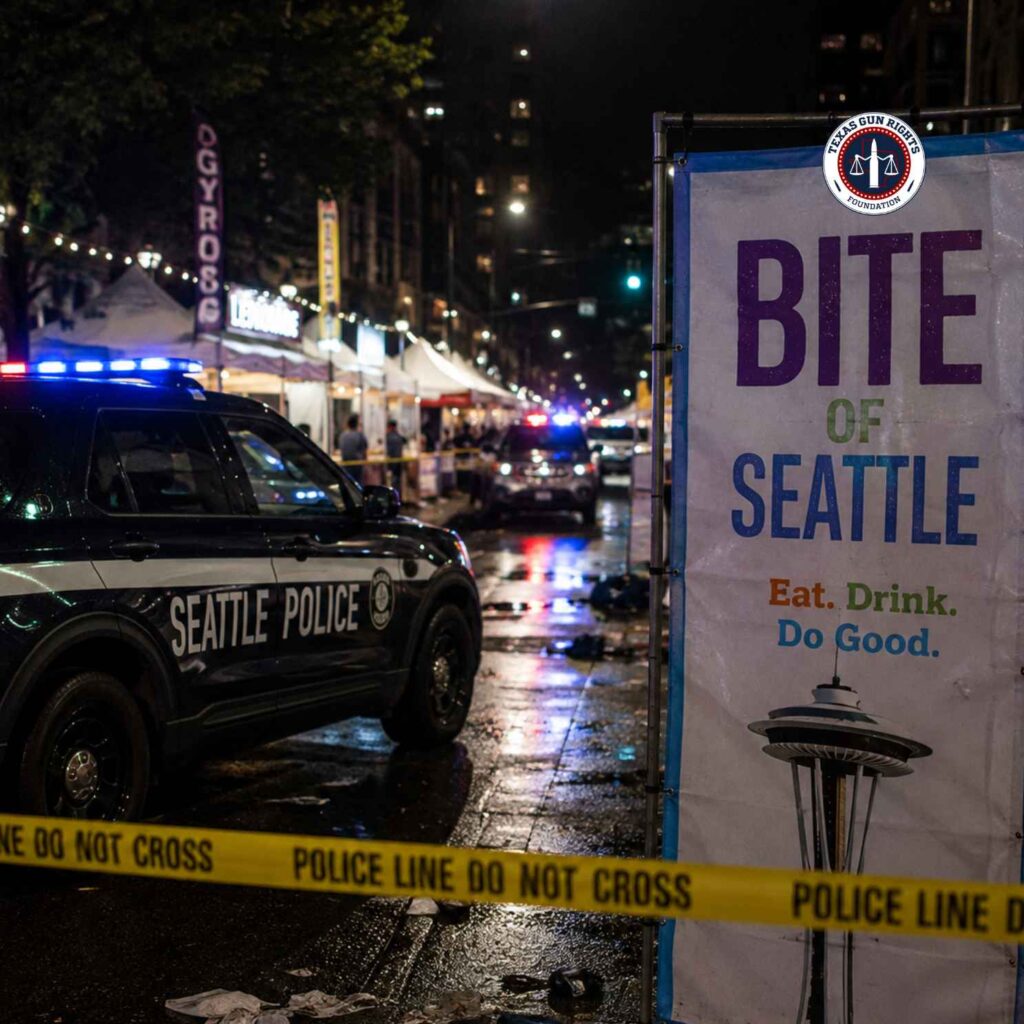
Police believe at least three people exchanged gunfire during the Bite of Seattle festival, including a 15-year-old now in juvenile custody, a 19-year-old suspected shooter who died at the scene, and at least one unidentified participant. Two apparent bystanders were killed, while four others — including a two-year-old child — were wounded. Investigators believe the confrontation may have been gang-related.
This was not a case in which otherwise lawful gun ownership suddenly produced violence.
It was an apparent public gunfight involving people already ignoring Washington’s extensive firearm restrictions.
Nearly Every Relevant Act Was Already Illegal
Police say the 15-year-old possessed an unserialized Polymer80 handgun equipped with a 33-round magazine.
Investigators also recovered a Glock 45 fitted with a conversion device allowing automatic fire and an extended magazine holding roughly 40 rounds. Police believe the converted Glock was fired during the shootout.
Washington law already prohibits knowingly possessing, receiving, transporting, purchasing, or transferring an untraceable firearm, subject to narrow exceptions. State law also generally prohibits possession of machine guns and parts intended to convert ordinary firearms into machine guns.
The arrested suspect was 15 years old.
Washington permits minors to possess firearms only under limited circumstances, including supervised training, hunting, target shooting, authorized competition, travel to those activities, or possession at home with parental permission. Carrying a handgun into a crowded festival gunfight plainly falls outside those exceptions.
The suspected shooters were not waiting for lawmakers to enact another restriction.
They were already ignoring the laws on the books.
The Festival’s Weapons Ban Did Not Stop Them
The Bite of Seattle’s published terms prohibited weapons and authorized searches of attendees, vehicles, and belongings.
That policy did not prevent several armed individuals from entering the event and opening fire.
It did, however, tell ordinary attendees to enter without weapons and depend entirely on event security and police protection.
That is the central weakness of gun-free-zone policies: they are most reliably followed by people who never intended to hurt anyone.
A posted rule cannot physically stop a gang member, prohibited juvenile, or armed criminal already willing to commit assault and murder.
“Seattle had a weapons prohibition, age restrictions, laws against untraceable firearms, and a ban on machine-gun conversion devices,” Texas Gun Rights Foundation President Chris McNutt said.
“The suspected shooters ignored all of them. The lesson is not that peaceful citizens need another restriction. The lesson is that violent offenders do not become harmless because politicians declared an area gun-free.”
Frontline Police Responded—The Policies Failed
Police officers assigned to the festival heard the shots and rapidly moved toward the gunfire. They rendered aid, began securing the scene, and took one suspected shooter into custody.
Their response should not be confused with the failures that allowed multiple armed participants to enter a supposedly weapons-free event.
Nor should the tragedy be used to blur the distinction between criminal firearm misuse and lawful gun ownership.
Calling every criminal shooting “gun violence” places the focus on the object rather than the people who deliberately ignored laws, event rules, and the lives of everyone around them.
It also creates political pressure for more restrictions on citizens who had nothing to do with the crime.
Another Law Is Not a Substitute for Enforcement
The Seattle shooting does not prove that criminal laws are unnecessary.
It proves that laws are not self-enforcing.
A serial-number requirement did not stop a prohibited juvenile from obtaining an unserialized handgun.
Washington’s machine-gun prohibition did not keep a conversion device off the street.
Age restrictions did not prevent minors and young adults from possessing handguns in public.
And the festival’s weapons ban did not keep guns out of the crowd.
The appropriate response is to determine how the suspected shooters obtained the firearms, identify every participant, disrupt the criminal networks involved, and impose meaningful consequences on those responsible.
It is not to punish lawful adults who complied with every existing restriction.
Punishing Lawful Gun Owners Misses the Point
Several important questions remain unanswered, including who fired the fatal rounds, who possessed the converted Glock, how each firearm was obtained, and what prior criminal or gang contacts the suspected shooters may have had.
Those facts should be established before officials use the tragedy to demand still more limits on lawful firearm ownership.
Two innocent people lost their lives in a place that promised weapons were prohibited.
Their families deserve more than another round of slogans.
They deserve an honest acknowledgment that people already forbidden from possessing the weapons involved were willing to ignore the law and fire into a crowded public event.
Texas Gun Rights Foundation will continue educating the public about the difference between violent criminal conduct and the peaceful exercise of the Second Amendment.
Those who support fact-based Second Amendment education can chip in to Texas Gun Rights Foundation and help expose policies that disarm lawful citizens while failing to stop violent offenders.