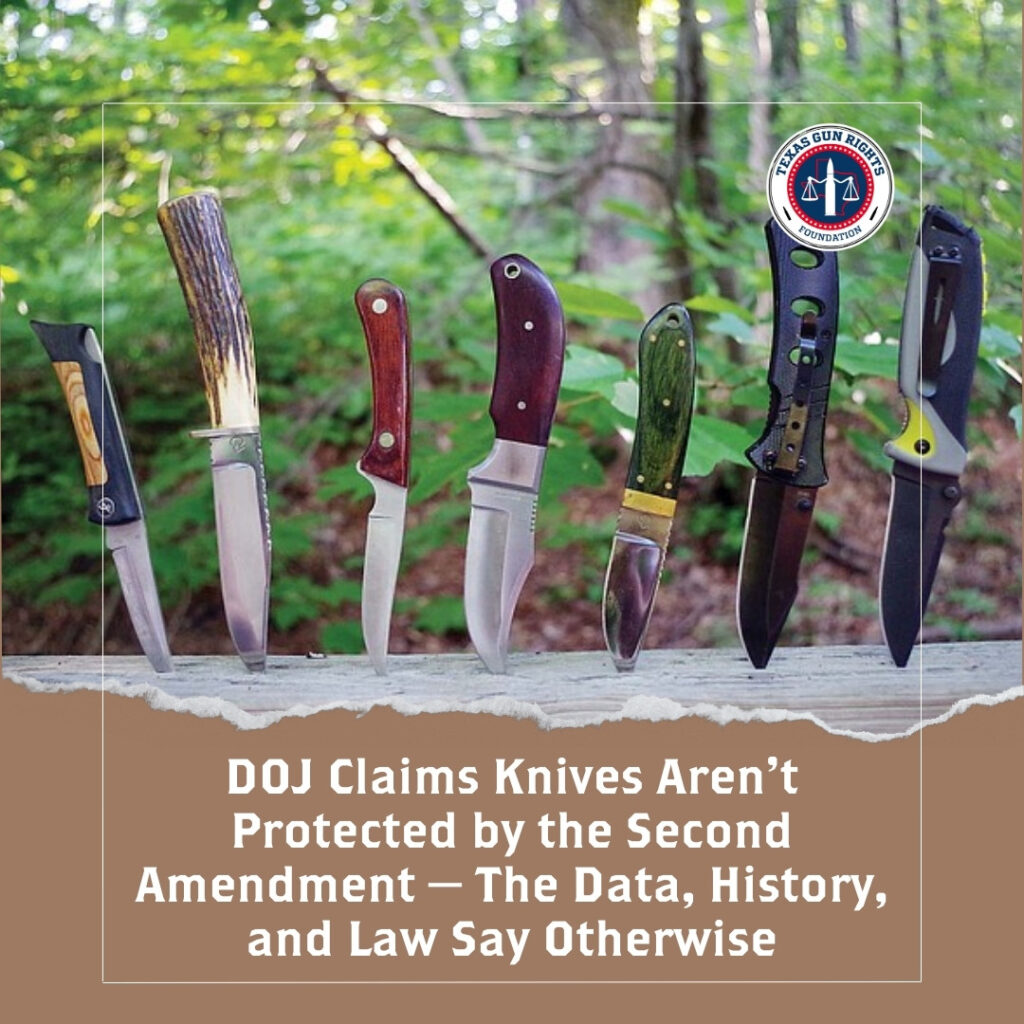
The Department of Justice recently advanced a remarkable argument in federal court: that certain knives—specifically automatic switchblade knives—are not protected by the Second Amendment.
According to the DOJ, knives are supposedly “inherently dangerous,” “easily concealable,” and historically subject to regulation, placing them outside constitutional protection.
That claim collapses under even modest scrutiny.
The Second Amendment does not protect “guns.” It protects the right to keep and bear arms. And historically, legally, and practically, knives are arms—among the oldest, most common, and most widely possessed arms in human history.
The Text of the Second Amendment Is Not Ambiguous
The Constitution does not say “firearms.” It does not say “muskets.” It says arms.
At the time of the Founding, the term “arms” encompassed all weapons commonly carried for lawful purposes—swords, knives, bayonets, pikes, clubs, and firearms. In fact, for much of American history, knives were more common than guns, especially for everyday carry.
To argue that the Second Amendment protects guns but not knives is to read a limitation into the Constitution that simply does not exist.
Supreme Court Precedent Rejects the DOJ’s Argument
In District of Columbia v. Heller (2008), the Supreme Court made clear that the Second Amendment protects arms “in common use” for lawful purposes.
Knives plainly meet that standard.
Millions of Americans carry knives every day—for work, utility, self-defense, and recreation.
Automatic knives, in particular, are widely used by first responders, military personnel, and civilians because they can be deployed with one hand—often a safety feature, not a criminal one.
The Court also rejected the idea that “dangerousness” alone removes constitutional protection. All arms are dangerous by definition. The relevant test is whether a weapon is both “dangerous and unusual.” Knives are neither.
The DOJ’s Crime Argument Is Unsupported by Evidence
The DOJ suggests knives are especially associated with criminal misuse. But empirical evidence does not support that claim.
FBI crime data consistently show that knives are used in a small fraction of violent crimes compared to other weapons—and far less often than blunt objects or even bare hands and feet.
Moreover, states that have repealed knife bans have not seen increases in violent crime attributable to knife carry.
Just as with firearms, lawful ownership and carry of knives is not correlated with higher crime rates. Criminals already ignore weapons bans. Law-abiding citizens do not.
Historical Restrictions Don’t Mean Constitutional Exclusion
The DOJ leans heavily on historical knife regulations to justify modern bans. But this reasoning is deeply flawed.
As the Supreme Court clarified in Bruen (2022), the existence of some historical regulations does not eliminate constitutional protection.
Many early regulations addressed manner of carry, not outright bans—and often targeted misuse, not possession.
If historical regulation alone were enough to strip protection, then firearms—heavily regulated in certain periods—would also fall outside the Second Amendment.
The Court explicitly rejected that logic.
Knives Are Core Self-Defense Arms
For many Americans, especially those who are elderly, disabled, or live in restrictive jurisdictions, knives may be the most accessible means of self-defense.
They require no ammunition, are reliable at close range, and are often the only defensive tool available in environments where firearms are prohibited.
Excluding knives from Second Amendment protection would disproportionately harm the most vulnerable populations.
A Dangerous Precedent
If the DOJ can declare knives unprotected today, it can narrow the definition of “arms” tomorrow.
This argument is not about knives alone. It is about whether constitutional rights are defined by text and history—or by bureaucratic preference.
The Second Amendment was written broadly for a reason. Its protection extends to all arms commonly possessed for lawful purposes. Knives easily qualify.
The DOJ’s position is not only legally incorrect—it is historically illiterate and empirically unsupported.
And if allowed to stand, it would represent a serious step backward for the right to keep and bear arms in America.
Do you agree Texas Gun Rights should fight for a Second Amendment that protects ALL arms? Chip-in below.