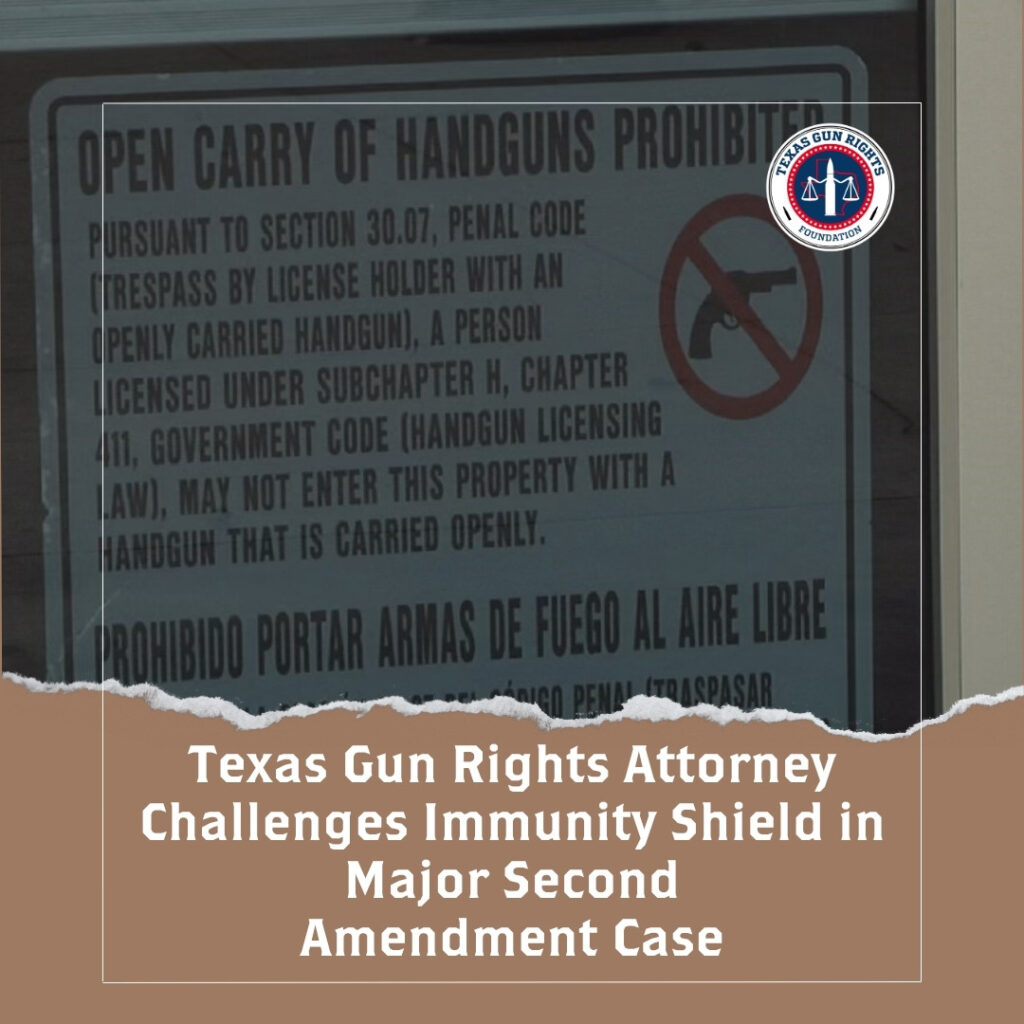
A critical Second Amendment case out of Texas is now at a pivotal moment — one that could determine whether government officials can ignore clear law and still escape accountability.
At the center of the case is CJ Grisham, a Texas Gun Rights Foundation attorney and retired law enforcement officer, who was repeatedly denied his lawful right to carry a firearm into a courthouse — despite holding valid federal and state credentials.
Now, after a federal magistrate judge recommended dismissing the case under the doctrine of qualified immunity, Grisham has formally objected, asking the district court to reject that recommendation and allow the case to move forward.
The outcome could have far-reaching implications for gun owners across Texas and beyond.
A Direct Conflict Between State Law and Local Policy
At its core, the dispute is straightforward.
Texas law explicitly allows certain qualified individuals — including retired law enforcement officers with proper credentials — to carry firearms in locations where others may not.
At the same time, Texas statutes make clear that local governments cannot impose stricter gun regulations than what state law permits.
Yet according to the lawsuit, Smith County officials enforced an internal policy that directly contradicted state law by denying Grisham entry, threatening him with arrest, and forcing him to disarm.
The legal question now before the court is whether those officials can avoid accountability by claiming qualified immunity, even after being shown the law and presented with valid credentials.
The Fight Over Qualified Immunity
Qualified immunity is meant to protect government officials when the law is unclear.
But Grisham’s filing argues this case is anything but unclear, pointing to plain statutory language and repeated notice to the officials involved.
Courts have long held that qualified immunity does not protect those who knowingly violate clearly established law.
If the district court agrees, this case could become an important test of whether that principle still has real force.
Texas Gun Rights President Chris McNutt says the case goes to the heart of a much bigger problem.
“If government officials can ignore clear law, enforce policies that are void, and then hide behind qualified immunity, then the rule of law itself is meaningless,” McNutt said. “This case is about whether the Second Amendment and the laws protecting it actually mean anything when it counts.”
What Happens Next
The case now moves to a federal district judge, who will review the magistrate’s recommendation and Grisham’s objections before issuing a final ruling on whether the case can proceed.
If the court allows the case to move forward, it could reinforce that government officials must follow clear statutory law and cannot override it with internal policies.
If dismissed, however, it could signal that even plainly written protections can be ignored without consequence.
And if the courts get this wrong, it could give government officials across the country a green light to ignore the law, knowing they may never be held accountable.
Texas Gun Rights is actively engaged in fights just like this — working to hold government officials accountable and defend the Second Amendment in the courts and beyond. Through the Texas Gun Rights Foundation, cases like this are part of a broader effort to restore the rule of law and protect the rights of law-abiding Americans.
Chip in $25, $50, or whatever you can today to help fund this fight and ensure gun owners are never left defenseless against government overreach.