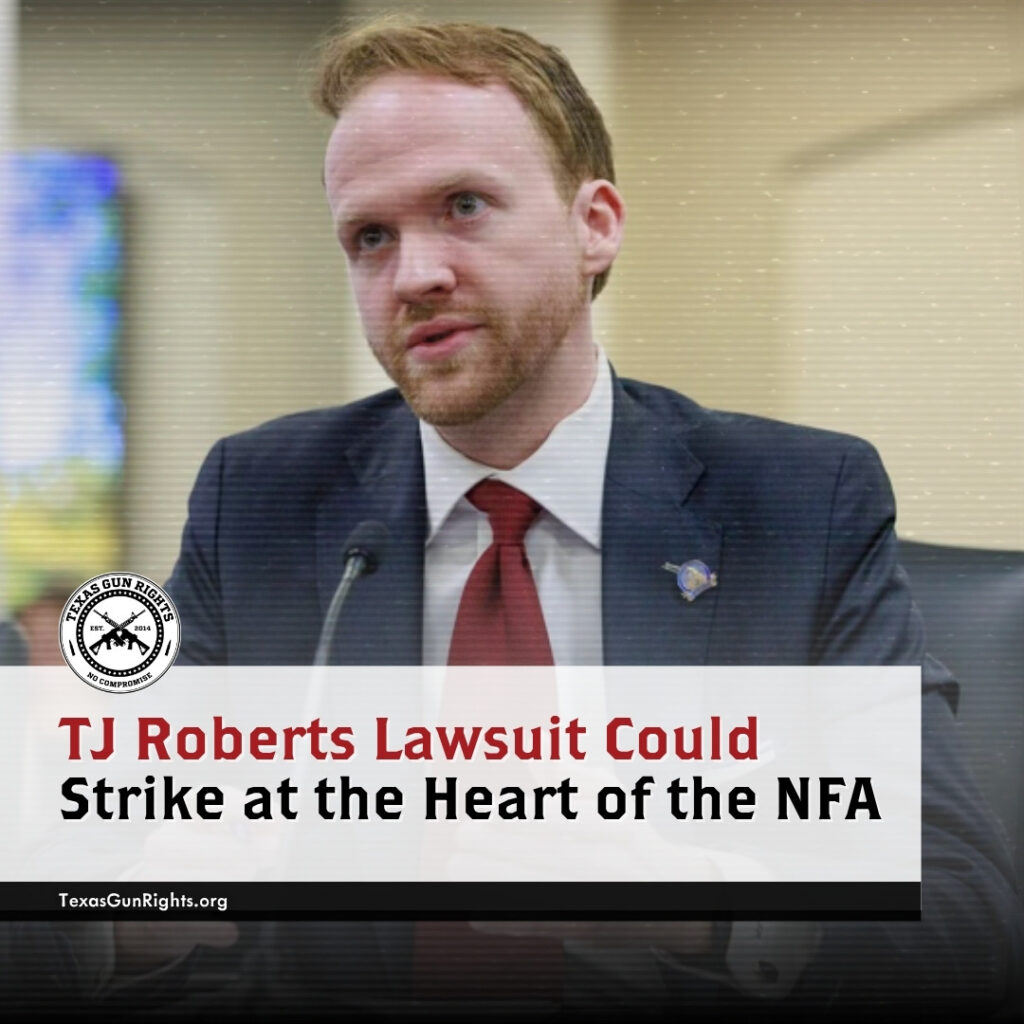
A growing legal challenge to the National Firearms Act (NFA) is gaining attention across the country, and at the center of it is someone Texas Gun Rights knows well.
Kentucky State Representative TJ Roberts is now part of a broader legal effort challenging the federal government’s authority to regulate and criminalize certain firearms under the NFA — a law that has been used for decades to justify federal registration schemes and restrictions on items like suppressors and short-barreled rifles.
But for Texas Gun Rights, this case is more than just another lawsuit.
It’s personal.
A Familiar Name in a National Fight
Years before entering public office or stepping into the courtroom, TJ Roberts was nearly part of the Texas Gun Rights team.
In 2020, Roberts had been in discussions to join Texas Gun Rights as a legislative director. Instead, he made a different choice: to attend law school.
That decision put him on a path that would ultimately place him at the center of one of the most important Second Amendment fights in the country today.
Now, as both an attorney and a state representative, Roberts is helping lead a legal challenge that could force courts — and potentially the U.S. Supreme Court — to confront a critical constitutional question:
Can the federal government continue to enforce the NFA when its original tax justification has effectively collapsed?
A Direct Challenge to Federal Gun Control
For decades, the NFA has been upheld largely on the basis that it is a tax law.
But with the tax component now reduced to zero in recent reforms, that foundation is being called into question.
Plaintiffs argue that without a legitimate taxing function, the federal government no longer has the constitutional authority to maintain the NFA’s registration requirements or criminal penalties.
If the courts agree, the implications could be sweeping — from ending federal registration requirements to dismantling long-standing restrictions on suppressors and short-barreled rifles.
Texas Gun Rights President Chris McNutt says the case reflects exactly the kind of challenge gun owners have been waiting for.
“For decades, the federal government has hidden behind the idea that the NFA was just a tax,” McNutt said. “But if there’s no tax, then there’s no justification. This case has the potential to strike at the core of one of the most abusive federal gun control schemes in history.”
How Likely Is Success?
While no case is guaranteed, the legal environment today is dramatically different than it was even just a few years ago.
Since the Supreme Court’s Bruen decision, courts are now required to evaluate gun laws based on the text of the Second Amendment and the historical tradition of firearm regulation.
That shift is already reshaping how courts evaluate gun laws.
In the case of the NFA, plaintiffs argue there is no historical analogue for the kind of sweeping registration system the federal government currently enforces.
If one of these challenges reaches the Supreme Court, it could give the Court its first real opportunity in generations to directly address the constitutionality of the NFA.
What a Win Would Mean
If Roberts and other plaintiffs are successful, the impact would be immediate and far-reaching.
Federal registration requirements could collapse.
Criminal prosecutions tied to NFA violations could be called into question.
And one of the most entrenched federal gun control frameworks in American history could begin to unravel.
Just as importantly, it would send a clear message:
That the federal government cannot rely on outdated legal theories to justify modern restrictions on constitutional rights.
A Growing Legal Movement Against the NFA
The Roberts case is not the only challenge working its way through the courts.
Other cases such as Silencer Shop v ATF, has also filed a major lawsuit targeting the federal government’s regulation of suppressors under the National Firearms Act.
Like Roberts’ case, that lawsuit argues the NFA cannot stand without its original tax foundation — and that the federal government lacks the constitutional authority to maintain its sweeping registration system.
Taken together, these cases represent a coordinated legal effort to force the courts to confront a question that has gone unanswered for decades.
“What we’re seeing right now is a coordinated push from across the country to finally challenge the NFA head-on,” McNutt said. “This isn’t just one case, it’s a movement.”
More Than One Case — A Broader Movement
This is exactly the kind of fight Texas Gun Rights was built for.
And if these cases succeed, it won’t happen because Washington decided to give up power, it will happen because gun owners forced the issue.
Texas Gun Rights is actively engaged in fights like this — in the legislature, in the courts, and across the country — to restore and defend the Second Amendment without compromise.
If you want to help fuel this fight and support efforts to dismantle unconstitutional gun control, chip in $25, $50, or whatever you can today to Texas Gun Rights.
Because victories like this don’t happen by accident — they happen when gun owners step up and make them possible.