A major legal fight is brewing in Texas, and the wrong decision could fundamentally weaken your right to defend yourself.
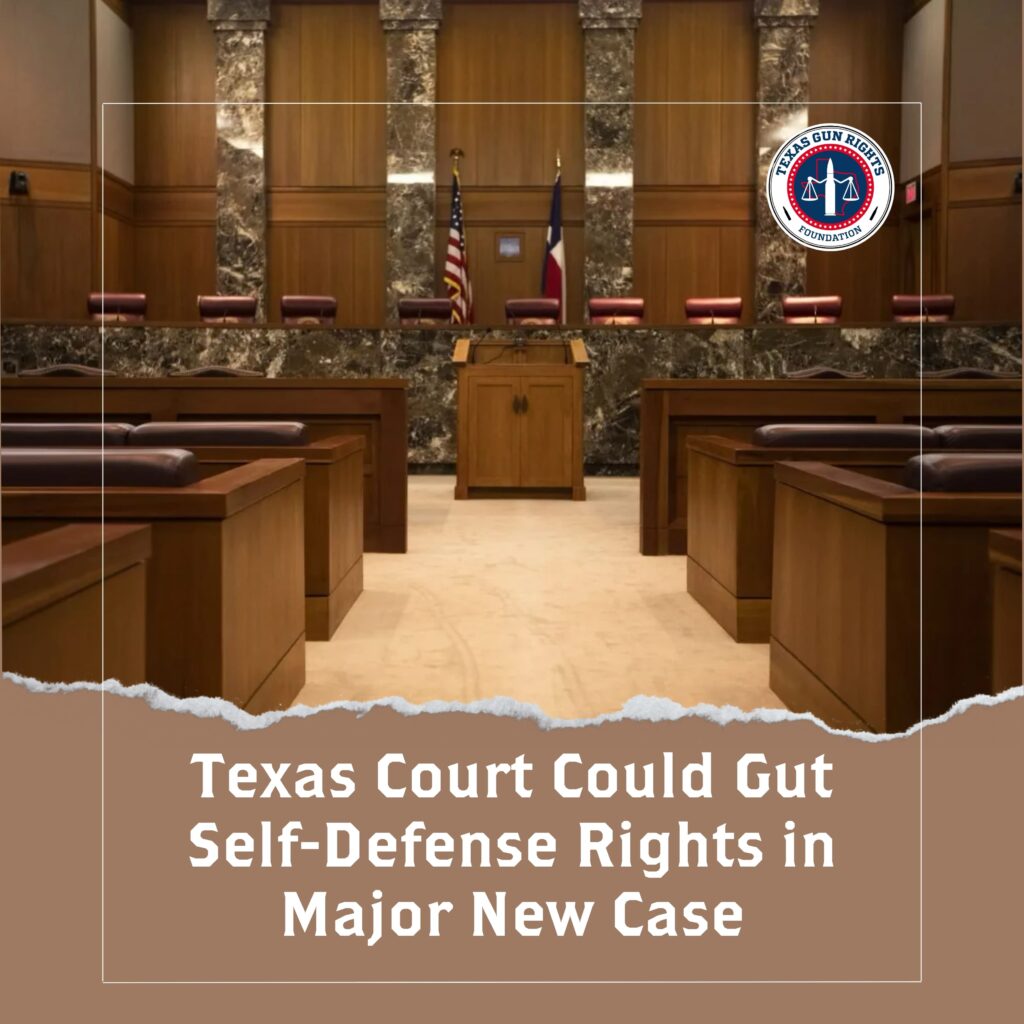
At the center of it is Texas v. Ballester, now before the Texas Court of Criminal Appeals (CCA).
While the case hasn’t broken into national headlines yet, the stakes are enormous: whether long-standing self-defense protections will be upheld, or quietly rewritten in favor of prosecutors.
A Self-Defense Case That Should Have Been Clear
The facts are the kind that gun owners know all too well: a tense dispute escalates, multiple individuals confront a homeowner, and in a matter of seconds, a life-or-death decision has to be made.
Israel Ballester was acquitted of murder but convicted on two counts of aggravated assault after a late-night confrontation turned violent.
He never denied using his firearm. Like Kyle Rittenhouse, his defense was straightforward: he acted to protect himself and his family in the face of a perceived deadly threat.
But unlike Rittenhouse, the jury never got a fair chance to apply the law correctly.
Instead, prosecutors were allowed to distort one of the most critical limits on self-defense — “provocation” — and the jury was never told what that word actually means under Texas law.
The Legal Sleight of Hand That Changed the Outcome
For over a century, Texas law has been clear: “provocation” is not about who started an argument or who escalated a confrontation.
It is a narrow legal concept requiring proof that a defendant intentionally provoked an attack as a pretext to harm someone under the guise of self-defense.
That standard exists for a reason. Without it, any prosecutor can argue that a defender “provoked” their attacker simply by being present, speaking up, or refusing to back down.
That’s exactly what happened here.
With no legal definition provided, prosecutors argued that Ballester “provoked everything,” essentially inviting the jury to treat the word as meaning whatever they thought it meant. And it worked.
The jury rejected his self-defense claim.
The appeals court later overturned the conviction, recognizing that the jury had been misled on a core issue that went to the heart of the case.
But now, instead of correcting the error, the government is doubling down.
A Direct Threat to Self-Defense Law
The State has asked the Texas Court of Criminal Appeals to take up the case — and in doing so, is positioning this case as a vehicle to weaken the long-standing definition of provocation.
If the court accepts that invitation, the consequences could be severe.
Self-defense would no longer depend on whether you faced an immediate and unlawful threat.
Instead, it could hinge on whether a prosecutor can convince a jury that you somehow “provoked” the situation, based on a vague and subjective standard.
We’ve seen this shift before.
In the Rittenhouse case, the argument wasn’t just about what happened in the moment, it was about whether he “should have been there” at all.
That same mindset, turning the focus away from the attacker’s conduct and onto the defender’s behavior, could become embedded in Texas law if the CCA gets this wrong.
And once that door is opened, it won’t close.
Texas Gun Rights Is Taking Action
Texas Gun Rights and the Texas Gun Rights Foundation are stepping in and preparing an amicus brief in the Ballester case to defend the integrity of self-defense law.
“This case is a direct threat to the fundamental right of self-defense,” said Chris McNutt, President of Texas Gun Rights.
“If ‘provocation’ is stretched beyond its legal meaning, then any law-abiding citizen can be second-guessed after the fact and denied the right to defend themselves. We will not allow the courts to gut self-defense protections without a fight.”
For years, the gun confiscation agenda has worked to restrict your rights through legislation.
Now the battle is shifting to the courts, where rights can be narrowed, reinterpreted, and weakened without a single vote being cast.
That’s exactly what’s on the line in Texas v. Ballester.
If the Texas Court of Criminal Appeals gets this wrong, it won’t just affect one case. It will change how every future self-defense claim is judged—and who gets the benefit of the doubt when seconds matter most.
Texas Gun Rights is stepping into that fight — because your rights don’t defend themselves.
Chip in today to help Texas Gun Rights defend your right to self-defense… before the courts gut it for good.