Public debates about firearms policy in the United States are usually framed as domestic disagreements over crime and public safety.
But a series of recent lawsuits targeting the American gun industry reveal a far more consequential development: a coordinated effort by foreign governments, assisted by U.S.-based advocacy groups acting as foreign agents, to use American courts to override American law.
This strategy deserves scrutiny not because of ideology, but because of what it implies for constitutional governance, democratic accountability, and national sovereignty.
When Gun Control Fails Legislatively, It Turns to Litigation
Congress enacted the Protection of Lawful Commerce in Arms Act (PLCAA) to stop a wave of lawsuits that sought to hold firearms manufacturers liable for crimes committed by third parties. Lawmakers recognized that such litigation was not grounded in evidence and created distorted incentives without reducing violent crime.
When repeated attempts to repeal PLCAA failed, gun-control advocates changed tactics.
Rather than persuading voters or lawmakers, advocacy networks began supporting lawsuits brought by foreign governments—most notably Mexico—arguing that U.S. gun manufacturers should be held responsible for cartel violence occurring outside U.S. borders.
The empirical case for this claim is weak. Mexico has some of the strictest gun laws in the world, yet suffers extreme levels of violence driven by corruption, organized crime, and failures of law enforcement. No credible research shows that imposing civil liability on U.S. manufacturers for criminal misuse abroad reduces violence. Yet the lawsuits persist.
The Money Trail and the Litigation Pipeline
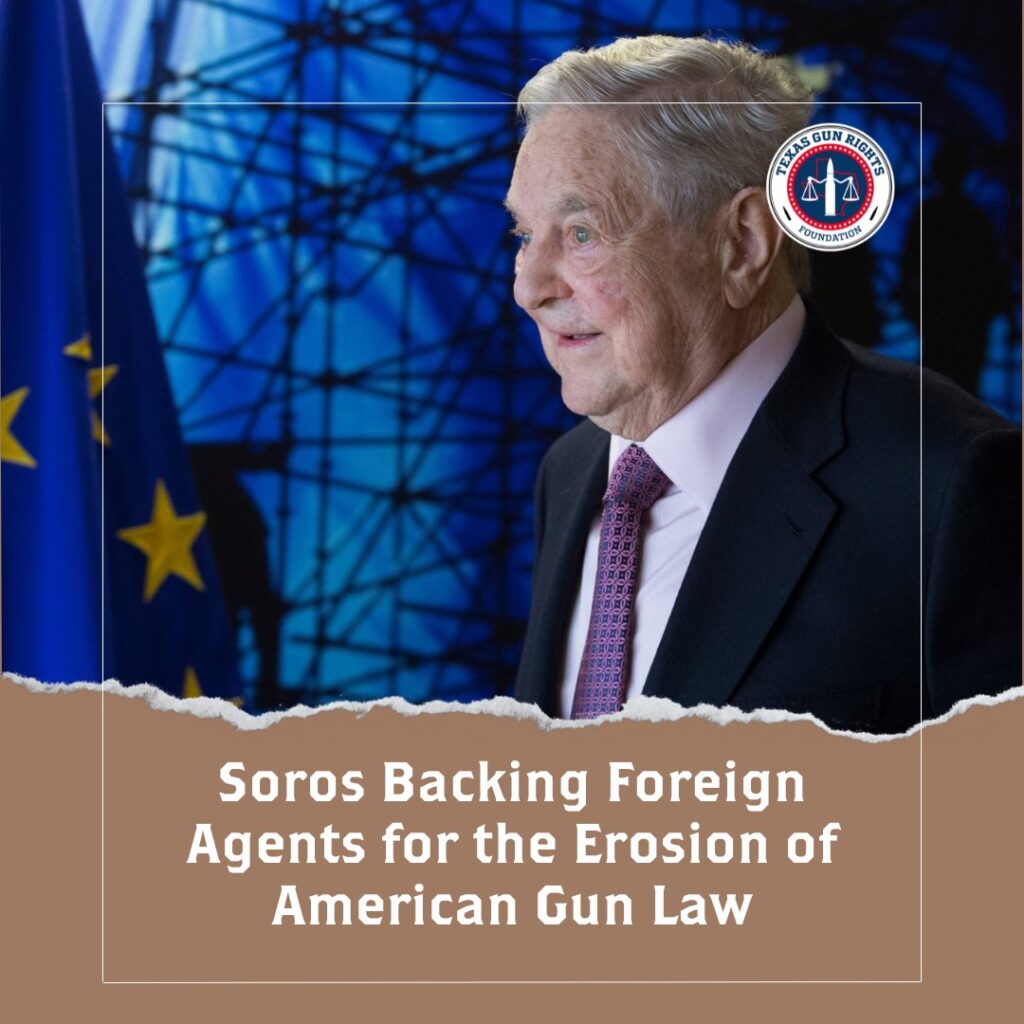
These cases are not isolated. Reporting has documented a consistent pattern: funding from George Soros’s Open Society Foundations flows to U.S.-based advocacy groups, which then provide legal and strategic support to foreign governments pursuing litigation against American gun manufacturers.
This funding-to-litigation pipeline reflects a broader trend in regulatory activism. When legislative avenues fail and empirical evidence does not support a policy goal, courts become the venue of choice. Litigation replaces persuasion, and judges are asked to do what voters and lawmakers would not.
This shift matters because it moves policy decisions away from democratic accountability and toward coercive legal pressure.
The Foreign-Agent Problem
What elevates these lawsuits from ordinary civil litigation into a constitutional concern is the role of U.S.-based advocacy groups that have registered under the Foreign Agents Registration Act (FARA) while assisting these cases.
By registering, these organizations have formally acknowledged they are acting on behalf of foreign principals. Yet they are simultaneously attempting to influence how U.S. courts interpret American constitutional rights and federal statutes.
The issue is not whether foreign governments are allowed to file lawsuits. The issue is whether foreign-agent-assisted litigation should be permitted to undermine democratically enacted U.S. law and reshape constitutional protections that bind only the American people and their government.
If this precedent is accepted, it will not stop with the Second Amendment. Any constitutional right or regulated industry could become vulnerable to similar strategies.
PLCAA as a Democratic Safeguard, Not an Industry Favor
PLCAA is often described by critics as a special carve-out for the firearms industry. That characterization is misleading.
PLCAA functions as a democratic safeguard. It ensures that decisions about firearms policy are made through legislatures—where evidence can be debated and voters can hold officials accountable—rather than through lawsuits that dispense with causation and liability standards.
This principle is not unique to guns. Similar protections exist across the economy because liability without fault produces poor policy outcomes and encourages legal abuse rather than public safety.
Why the Supreme Court Was Right—and Why the Risk Remains
The U.S. Supreme Court unanimously rejected Mexico’s lawsuit against Smith & Wesson, reaffirming that PLCAA means what Congress intended it to mean. That decision was necessary and correct.
But it did not eliminate the underlying strategy.
As long as well-funded advocacy networks believe foreign plaintiffs can be used to circumvent U.S. law, similar lawsuits will continue—testing courts, eroding norms, and inviting foreign influence into areas traditionally reserved for domestic governance.
Evidence Still Matters
Decades of criminological research consistently show that:
- Violent crime is driven by a relatively small number of repeat offenders
- Lawful firearms manufacturers are not the cause of criminal misuse
- Gun ownership rates do not reliably predict violent crime rates
- Litigation targeting lawful supply does not deter criminal behavior
When evidence fails to support a policy goal, shifting venues—from legislatures to courts, from domestic plaintiffs to foreign governments—does not make the policy sound. It merely obscures accountability.
A Precedent Americans Should Reject
What is at stake extends beyond the gun industry or the Second Amendment. The broader question is whether American constitutional rights and federal statutes can be reshaped through foreign-backed litigation strategies that bypass voters, evidence, and national sovereignty.
Sound public policy depends on measurable outcomes, transparent debate, and democratic consent. When those are replaced by litigation pressure and foreign influence, the rule of law is weakened—regardless of the policy goal.
Americans should insist that constitutional rights rise or fall on evidence and democratic choice, not on who can assemble the most creative legal workaround when the data do not cooperate.