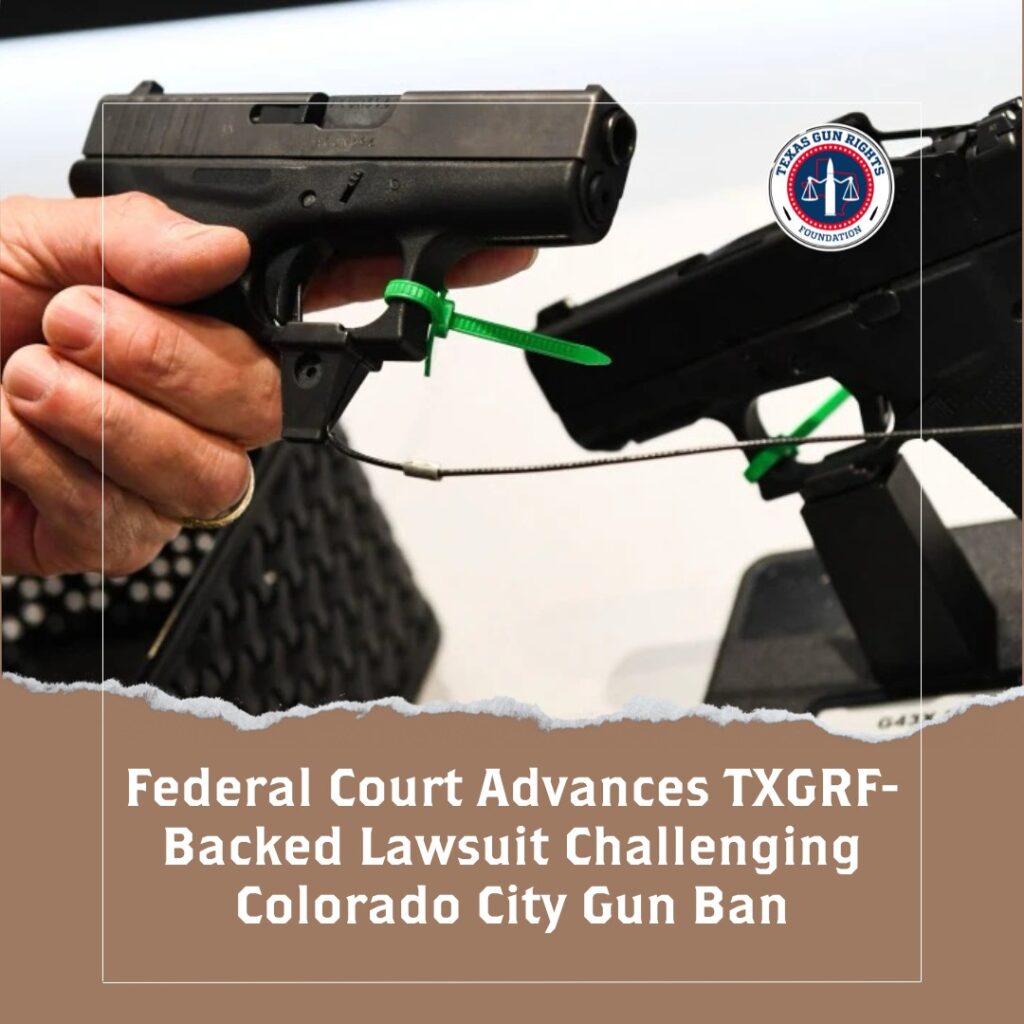
A federal judge has allowed a Second Amendment lawsuit against Colorado City, Texas to move forward, ruling that the city’s policy barring licensed handgun carriers from a multi-use civic center and at governmental open meetings may exceed constitutional limits.
The case, Havens v. City of Colorado City, was filed by Texas Gun Rights Foundation attorney C.J. Grisham and supported by the Texas Gun Rights Foundation (TXGRF) on behalf of plaintiff Jason Havens, a licensed handgun carrier who sought to attend city council meetings while lawfully armed
The Dispute
According to the complaint, Colorado City posted signage prohibiting firearms throughout its entire civic center, not merely the specific room where a city council meeting was being held.
Havens repeatedly informed city officials that Texas law limits firearm prohibitions during open meetings to the room or rooms where the meeting occurs and provides exceptions for licensed carriers.
Despite those warnings, Havens alleged he was ordered to leave, physically removed by the police chief, and later threatened with arrest unless he disarmed.
After Havens filed complaints, the Texas Attorney General’s Office notified him that the city removed the signage and committed to complying with state law
Havens sued the city and individual officials under federal civil-rights law, asserting violations of the Second Amendment and Fourth Amendment, among other claims. The city moved to dismiss.
The Ruling
U.S. District Judge James Wesley Hendrix granted the motion in part and denied it in part.
Most notably, the court held that Havens plausibly alleged a Second Amendment violation by the City, allowing that claim to proceed under Monell municipal-liability principles.
The judge explained that while certain locations may qualify as “sensitive places,” the city’s blanket prohibition across an entire multi-use government building may regulate firearms beyond what historical tradition permits, particularly where the ban extends beyond the meeting room itself.
The court also found Havens plausibly alleged a Fourth Amendment unreasonable-seizure claim based on his physical removal.
However, the judge dismissed claims against the individual officials on qualified-immunity grounds and dismissed several other claims, including First and Ninth Amendment theories and a civil-conspiracy claim.
Despite dismissing the individual claims on qualified immunity, the court found that those same individual officers had violated Mr. Havens’ Second and Fourth Amendment rights, but were granted qualified immunity due to the lack of clearly established case law on the issue.
The Second and Fourth Amendment claims against the City remain the case’s core moving forward
Help TXGRF Continue the Fight
The decision underscores a growing post-Bruen scrutiny of broad government gun bans.
While legislatures and municipalities may restrict firearms in narrowly defined “sensitive places,” the court signaled that cities cannot simply declare entire government buildings gun-free without historical support.
As the case proceeds, the ruling places Colorado City’s former policy squarely before the court and adds to the developing body of law clarifying where and how governments may regulate the right to keep and bear arms.