Across the globe, the struggle between citizens and authoritarian governments is playing out in real time — and Americans would be foolish to treat it like a distant foreign drama.
In Iran, widespread protests have surged across major cities as citizens openly challenge a regime that has ruled through fear, censorship, and brute force.
Reports indicate dozens have been killed in recent days, thousands arrested, and security forces have responded with gunfire and mass crackdowns.
Videos circulating online show crowds chanting “Death to the dictator,” underscoring the intensity of the uprising and the desperation of a population that has had enough.
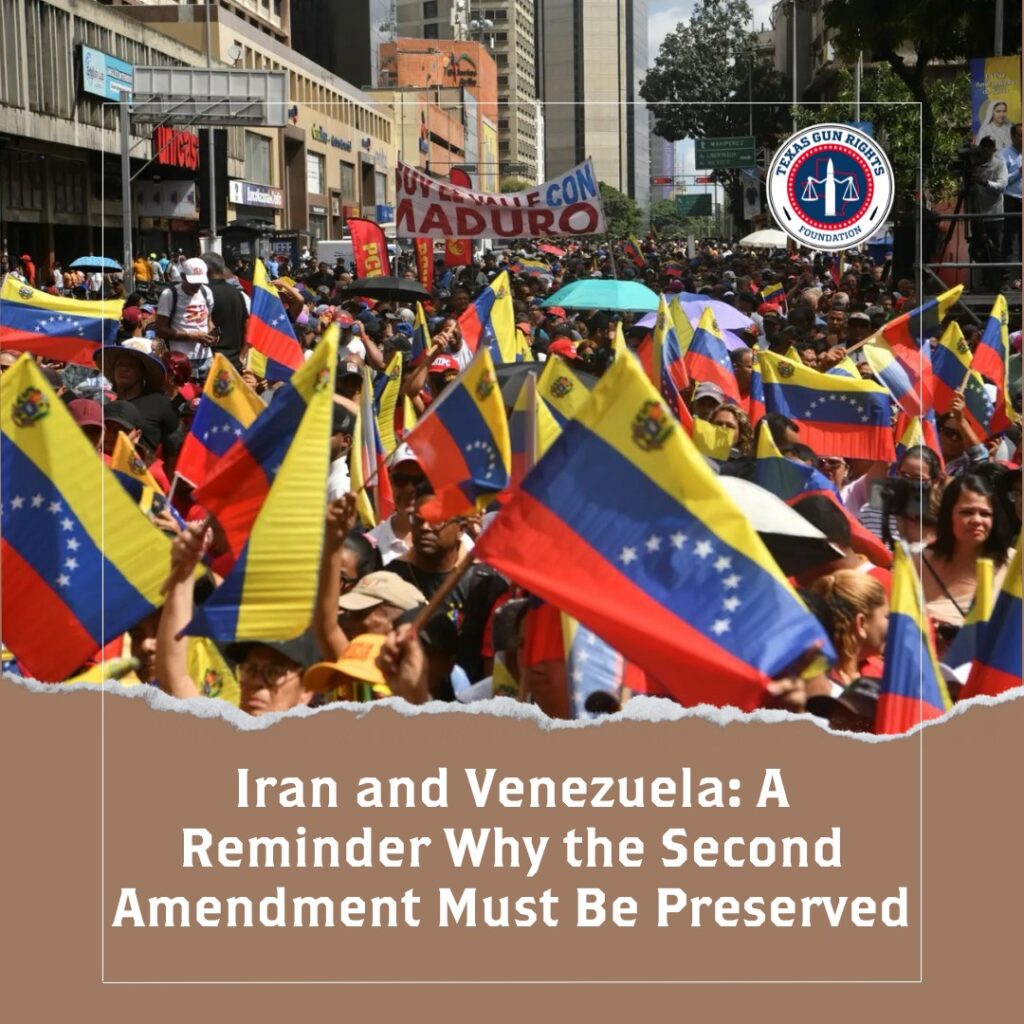
And in Venezuela, a country once among the wealthiest in Latin America, years of authoritarian consolidation and political repression have shown how quickly a society can collapse when the government becomes unaccountable to the people. Economic devastation, state violence, and political persecution became routine as those in power tightened their grip and crushed dissent.
In both cases, the pattern is unmistakable: when the government has a monopoly on force and citizens are left disarmed and helpless, reclaiming freedom becomes brutally expensive.
The Real Lesson Americans Should Learn
The most sobering truth about tyranny is that it rarely arrives overnight. It comes in stages, and the first stage is almost always the same:
Disarm the people.
Once the population is politically powerless and physically defenseless, resistance becomes nearly impossible. At that point, citizens aren’t negotiating with their government, they’re pleading with it.
That’s exactly why Texas Gun Rights has warned for years that the Second Amendment is not simply about sport, hunting, or tradition. It is about whether ordinary people retain the ability to protect themselves and preserve liberty when government power becomes abusive or lawless.
Freedom Is Easy to Lose and Painful to Regain
Iran’s protesters don’t have a Second Amendment.
They don’t have a codified right to keep and bear arms.
When the state decides to crack down, there is no meaningful deterrent, only the threat of prison, beatings, or death.
And history is clear: when a government is willing to shoot its own people in the streets, it is not a government that fears elections. It is a government that fears resistance.
In Venezuela, the same reality has played out in a different form, where the state, the courts, the media, and enforcement mechanisms were steadily captured and weaponized against political opponents.
Once that power was centralized, the people were left with few options beyond fleeing, suffering, or submitting.
This is the cost Americans must understand:
When you surrender your freedom, you don’t get it back by filing a complaint: you get it back through hardship, and often through blood.
No Compromise Means No Retreat
That is why Texas Gun Rights’ message matters now more than ever:
We must never give a millimeter on the Second Amendment.
Not for “Red Flag” gun confiscation laws. Not for registration schemes. Not for bans dressed up as “reasonable restrictions.”
Not for taxes, permits, waiting periods, or backdoor enforcement traps.
Because every “compromise” becomes the foundation for the next restriction — and the next — until the right becomes a privilege, and the privilege becomes permission.
Iran and Venezuela are not just cautionary tales. They are reminders that governments do not hesitate to seize power when citizens lack the means to stop them.
Americans should not have to learn that lesson the hard way.
Freedom is priceless.
And once you let government take it, the cost to reclaim it is far higher than most people can imagine.
That is why the Second Amendment must remain exactly what it was meant to be: a line in the sand.