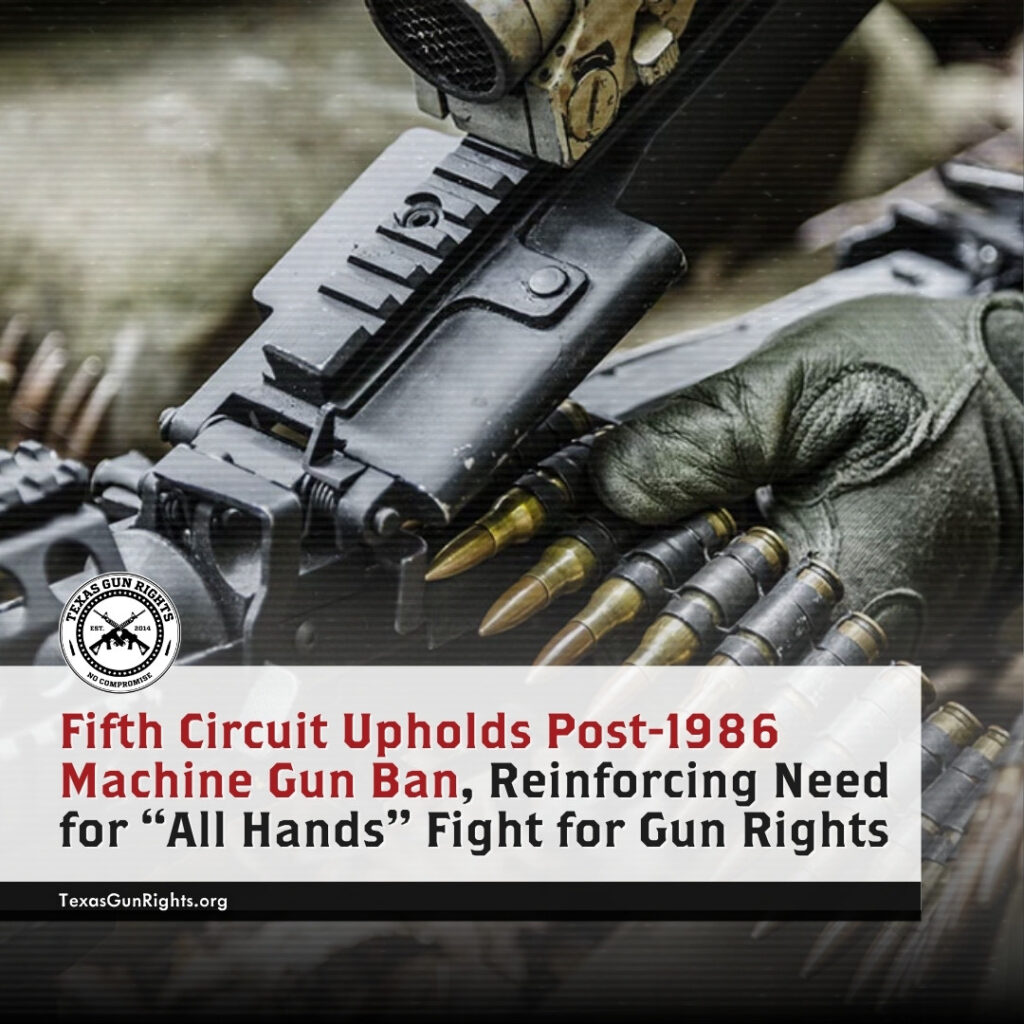
The U.S. Court of Appeals for the Fifth Circuit has upheld the federal ban on civilian possession of machine guns manufactured after May 19, 1986, leaving in place one of the most restrictive gun laws on the books and reminding Second Amendment supporters that court victories alone are not enough to safeguard freedom.
The restriction stems from the 1986 Firearm Owners’ Protection Act (FOPA), specifically the Hughes Amendment, which froze the civilian machine gun registry.
In practical terms, it means law-abiding Americans can only legally own machine guns registered prior to the 1986 cutoff, creating an artificially limited supply and driving prices into the tens of thousands of dollars.
The Fifth Circuit’s decision represents another example of a harsh reality gun owners have learned repeatedly over the decades: the courts can be a critical battleground, but they are not a guaranteed shield.
Even after the U.S. Supreme Court’s landmark Bruen decision, which emphasized that gun restrictions must be consistent with the nation’s historical tradition of firearm regulation, lower courts have continued to uphold long-standing federal gun laws, especially those involving weapons politicians and bureaucrats classify as “dangerous” or “unusual.”
For gun rights advocates, the ruling underscores that relying solely on the courtroom to defend the Second Amendment is a gamble, and one that can cost Americans years of liberty while cases crawl through the appellate process.
The reality is simple: freedom is not secured in one place. It must be defended everywhere.
That means litigation. But it also means legislative action, aggressive political organizing, and turning out voters who will punish politicians for siding with the gun confiscation agenda.
In Texas, organizations like Texas Gun Rights have pushed the “all hands” approach, arguing that gun owners must fight on every front: the courts, the Capitol, Congress, and the ballot box.
That’s how they’ve secured victories like Constitutional Carry, a ban on “red flag” laws, and legal victories on pistol stabilizing braces and forced reset triggers.
They have repeatedly warned that gun rights are lost when gun owners grow complacent, believing that one court ruling or one election cycle will settle the issue permanently.
The Fifth Circuit’s decision is a reminder that even in a circuit widely viewed as friendly to gun rights, there are limits to what the judiciary will do.
When judges refuse to strike down federal restrictions, gun owners must be ready to take the fight to lawmakers and elections, forcing reforms through political pressure rather than waiting on another panel of judges to “get it right.”
For Second Amendment supporters, the lesson is clear: the fight is not theoretical, and it is not passive.
Gun owners must adopt an “all hands” posture, refusing compromise, refusing surrender, and refusing to treat the right to keep and bear arms like a privilege that can be negotiated away.
Because if Americans are serious about defending the Second Amendment, they cannot rely on one branch of government to protect it.
They have to fight for it everywhere.