
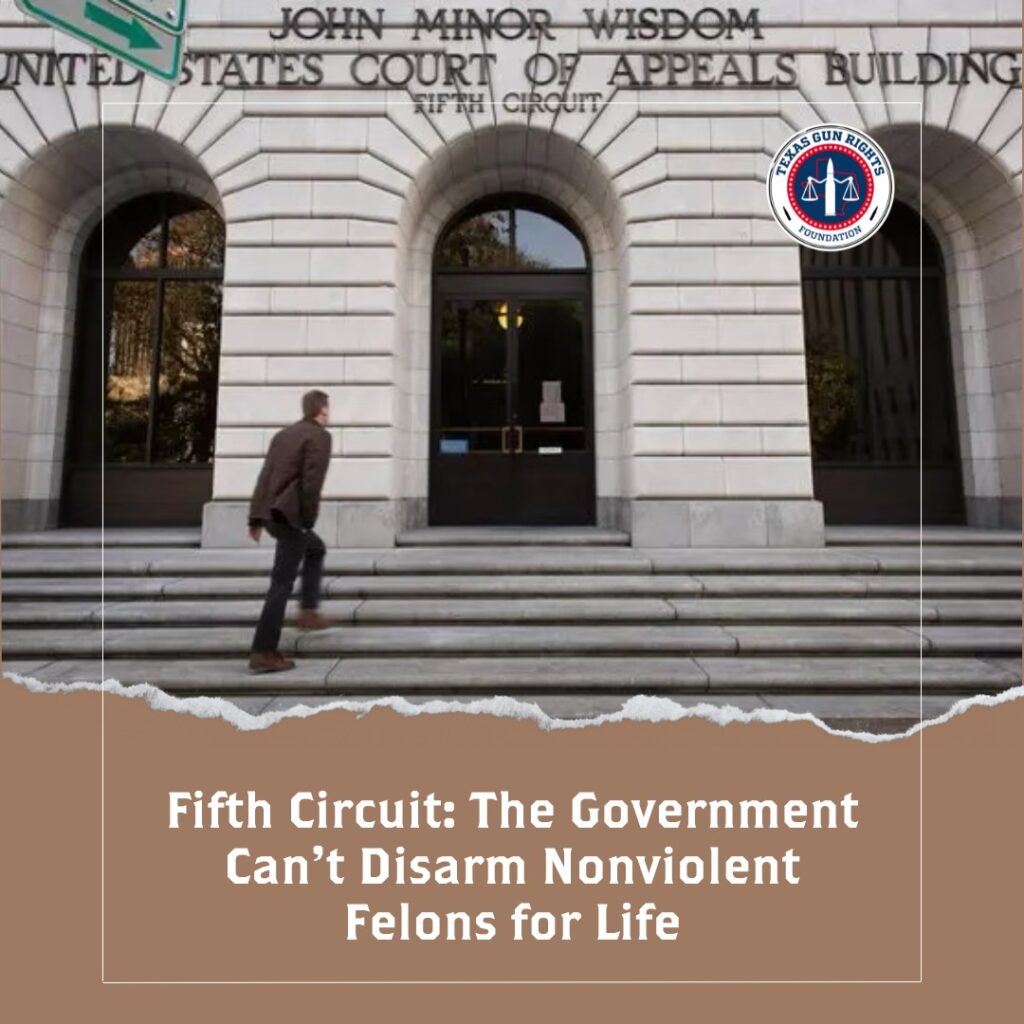
The case is United States v. Hembree, and it deals with the federal “felon-in-possession” law, 18 U.S.C. § 922(g)(1), which makes it a crime for any convicted felon to possess a firearm.
For decades, this law has operated like a blunt instrument: once you have a felony on your record, your Second Amendment rights are treated as permanently forfeited — even if your crime had nothing to do with violence, firearms, or threats to others.
That is exactly what the Fifth Circuit rejected.
What Hembree Was About
Charles Hembree was prosecuted under § 922(g)(1).
His only prior felony conviction was not for murder, assault, armed robbery, or any violent offense. It was a 2018 Mississippi felony conviction for simple possession of methamphetamine.
In other words, the government’s theory wasn’t that Hembree had committed a violent crime. It was that because he once committed any felony at all, he could be disarmed for life.
What the Fifth Circuit Decided
The Fifth Circuit ruled that the federal felon-in-possession ban is unconstitutional as applied to Hembree, and it reversed his conviction.
This is not a minor technical ruling.
It is a direct application of the Supreme Court’s Bruen test, which requires the government to justify modern gun restrictions by pointing to America’s historical tradition of firearm regulation.
In plain English: the government can’t just claim “public safety” and be done with it. It has to prove that disarming a person like Hembree fits the kind of gun restrictions that existed when the Second Amendment was adopted.
The Fifth Circuit said the government failed to do that.
Why the Government’s Arguments Failed
The government tried to justify disarming Hembree by pointing to historical restrictions involving “contraband,” like stolen property or fraud-related offenses.
But the Fifth Circuit rejected those comparisons because they involved theft, deceit, or fraud — not simple drug possession.
The government also leaned heavily on the broad theory that drug crimes are “dangerous,” and that dangerous people can be disarmed.
But the Fifth Circuit emphasized that its precedent requires focusing on the actual predicate felony itself, not speculation about what a person might do.
The court also contrasted this case with another Fifth Circuit decision, Kimble, which upheld disarmament for drug traffickers. The Fifth Circuit made clear that drug trafficking is a much closer fit to historical analogues than “occasional drug users,” and that simple possession does not automatically justify permanent disarmament.
What This Decision Means
The practical significance of Hembree is simple but profound: the government does not have a blank check to permanently strip Second Amendment rights from nonviolent felons.
That matters because millions of Americans have felony records for nonviolent offenses, including drug possession and paperwork crimes.
And it matters because gun bans are often enforced selectively, while violent criminals frequently evade meaningful punishment through plea deals, early release policies, and revolving-door prosecution.
The result is a perverse system: people who have proven they are violent threats too often remain on the streets, while nonviolent offenders who served their sentences are treated as permanently second-class citizens.
Hembree pushes back on that.
Restoring Rights Is Common Sense
Texas Gun Rights supports restoring the rights of nonviolent felons who have served their time and are no threat to society.
If someone has completed their sentence, paid their debt, and is trusted enough to live freely in society, they should not be denied fundamental constitutional rights for the rest of their lives.
As Texas Gun Rights President Chris McNutt put it:
“If you are no threat to society, and have served your time, you should have your rights restored. If you can’t be trusted with your rights, you should probably still be locked up.”
Texas had an opportunity to fix this legislatively.
In 2025, State Rep. Wes Virdell filed a HB 2759 to restore gun rights for nonviolent felons, and McNutt testified in support. The bill never made it out of committee.
So the Fifth Circuit’s decision won’t end the debate.
But Hembree is a clear reminder that constitutional rights do not depend on bureaucratic convenience. They depend on law, history, and the limits the Constitution places on government power.
And that is a fight worth continuing.