
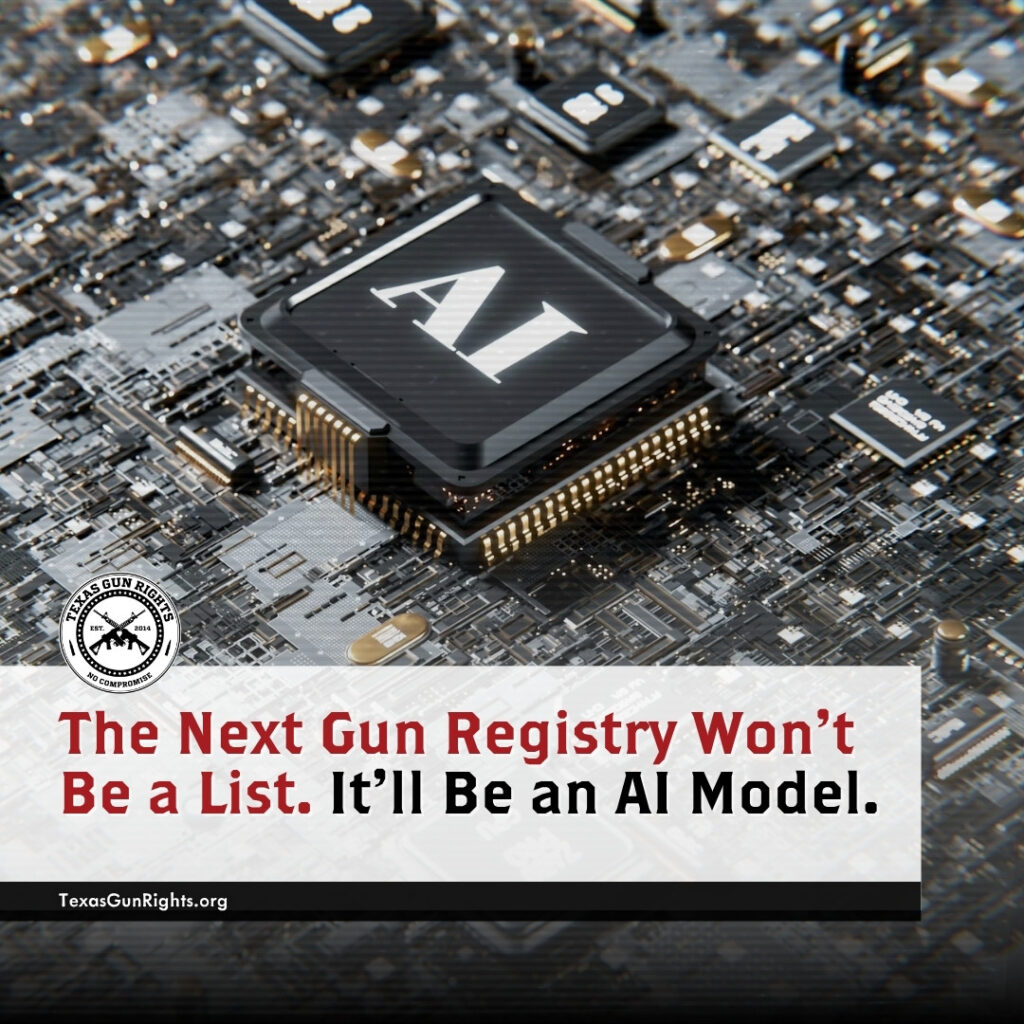
Texas Gun Rights warns artificial intelligence could turn ATF’s 4473 stockpile into the shadow registry Congress banned
Congress banned the federal government from creating a national gun registry long ago.
Now the question is whether artificial intelligence could allow the government to build one anyway.
Not by creating a database labeled “registry.”
Not by passing a new law.
Not by admitting what they are doing.
But by feeding existing government records into AI systems capable of extracting, connecting, and inferring who owns what.
That should scare every gun owner in America.
A new working paper from the University of Wyoming Firearms Research Center warns that modern artificial intelligence may render the federal gun registry ban obsolete unless Congress acts.
The paper argues that AI could create “registry-equivalent knowledge” from lawfully held federal data without the government ever building a traditional registry at all.
In plain English: the government may not need to build a registry if AI can infer one.
And the ATF is already sitting on the raw material.
ATF Is Sitting on a Mountain of Gun Owner Records
ATF currently holds hundreds of millions of firearm transaction records from gun dealers that went out of business.
The paper cites approximately 921 million digitized firearm transaction records, and notes the number has likely grown because ATF continues processing millions of pages of dealer records every month.
These records include the kind of information gun owners should never want centralized in Washington:
- Names.
- Addresses.
- Dates of birth.
- Firearm descriptions.
- Serial numbers.
- Dealer information.
- Transaction records.
ATF’s defense has long been that these records are not a registry because they are not searchable by purchaser name.
That excuse was weak before.
With AI, it may become laughable.
“Not Searchable” Is Not Good Enough Anymore
ATF has argued that its digitized records are not a registry because ordinary search functions are disabled.
In other words, the agency says it may have the records, but it supposedly cannot just type in your name and search them like a normal database.
That is the kind of Washington technicality gun owners are sick of hearing.
The paper explains why that defense is breaking down. Modern AI systems do not need a clean, traditional, searchable database to extract information. They can process document images, recognize text, identify patterns, connect records, and generate structured outputs from messy data.
So the real question is no longer whether ATF has a database with a search bar.
The real question is whether the federal government can use AI to obtain the same practical result.
If AI can take scanned Form 4473s and out-of-business records, extract names and firearm data, connect those records with other federal systems, and produce ownership predictions, then the government has created the functional equivalent of a registry.
Call it whatever you want, it is still an illegal registry of gun owners.
Registry-Equivalent Knowledge
The working paper uses the phrase “registry-equivalent knowledge” to describe the danger.
That means a government system may not look like an old-fashioned registry, but it can still produce the same result.
For example, AI could potentially help the government identify firearms likely owned by a specific person, generate lists of probable gun owners in a geographic area, or connect a firearm or serial number to a likely owner outside the traditional trace process.
That is exactly the kind of power Congress meant to forbid.
Congress did not ban gun registries because it hated filing cabinets, congress banned gun registries because government lists of gun owners are dangerous.
They are dangerous whether they are built by hand, stored in a database, or inferred by an AI model.
“All Government Data” Means Gun Records Too
This danger becomes even more serious when combined with the federal government’s broader push to integrate massive data sets into AI systems.
The paper discusses federal AI policy moving toward broad government-data ingestion, including statements from White House technology officials about feeding government data into AI models.
The concern is simple: ATF is a federal agency, and ATF records are government data. Unless firearm transaction records are specifically walled off, they could be swept into broader AI infrastructure.
That cannot happen.
No federal AI project should be allowed to ingest, train on, analyze, structure, or infer firearm ownership from Form 4473s, out-of-business dealer records, NICS metadata, multiple-sale reports, eTrace data, NIBIN records, or NFA data.
Gun owner records should not be treated like ordinary government paperwork.
They are records tied directly to the exercise of a constitutional right.
The Law Must Catch Up
Federal law already says the government cannot create “any system of registration of firearms, firearms owners, or firearms transactions” under 18 U.S.C. § 926(a).
But Congress wrote that language in 1986.
Back then, lawmakers were thinking about paper files, mainframes, and searchable databases. They were not thinking about AI models capable of reconstructing firearm ownership through inference, aggregation, image recognition, and record linkage.
The paper argues that this is exactly the gap Congress must close. The law should cover not just formal registries, but any computational process that gives the government registry-equivalent knowledge.
That means no AI model.
If the system can tell the government who likely owns which guns, it should be treated as a prohibited registry.
A Software Toggle Is Not a Safeguard
One of the most disturbing points in the paper is how fragile the current supposed safeguard really is.
ATF’s position largely rests on the idea that its digitized records are not searchable by purchaser name.
But the paper notes that if the underlying records already contain the data, then the searchability problem may be more like a software configuration issue than a true legal barrier.
That is insane.
The Second Amendment cannot depend on Adobe settings.
Gun owners should not have to trust that federal bureaucrats will behave because a search function is disabled or a file is stored as an image.
If the government has the records, and modern AI can extract the data, then the threat exists.
The only real solution is to destroy the records and prohibit AI inference from firearm transaction data altogether.
This Is Why ATF Records Retention Must End
This is also why the current ATF records-retention fight matters so much.
The longer ATF keeps these records, the more dangerous they become.
In the past, the danger was a paper registry, then it was a searchable database, and now it is AI inference.
The gun confiscation lobby does not need to win all at once. They just need to keep the records, centralize the data, wait for the technology to improve, and let the federal gun control machine do the rest.
Texas Gun Rights is not waiting for that to happen.
We want these records destroyed, we want ATF’s out-of-business record stockpile dismantled, and we want firearm transaction records walled off from federal AI systems.
Congress needs to update the law so “any system of registration” includes AI-generated registry-equivalent knowledge.
And the federal gun control machine needs to be ripped out by the roots before the next anti-gun administration gets its hands on it.
Help Texas Gun Rights keep fighting to destroy ATF’s gun owner record stockpile, stop AI registry schemes before they begin, and dismantle the federal gun control machine.