When policymakers debate gun laws, they often do so in the abstract. But occasionally, real-world events provide a clearer test of how those policies function under pressure.
The recent attempted assassination of President Trump at the Washington Hilton — during one of the most heavily secured events in the country — is one such case.
It highlights a recurring and well-documented reality: laws restricting firearms do not stop determined attackers. The ability to respond to violence does.
Washington, D.C. has long maintained some of the most restrictive firearm regulations in the United States. These laws are often justified on the grounds that tighter controls will reduce the likelihood of violent incidents.
If that assumption held true, one would expect such jurisdictions to be less vulnerable to attacks of this nature.
Yet the incident occurred anyway.
The attacker did not operate within the legal framework. He did not weigh compliance requirements or licensing rules. Like many individuals who commit acts of violence, he acted outside the system entirely.
This is consistent with what research has shown for decades: those intent on carrying out attacks are not deterred by legal restrictions governing lawful behavior.
What Actually Stopped the Threat
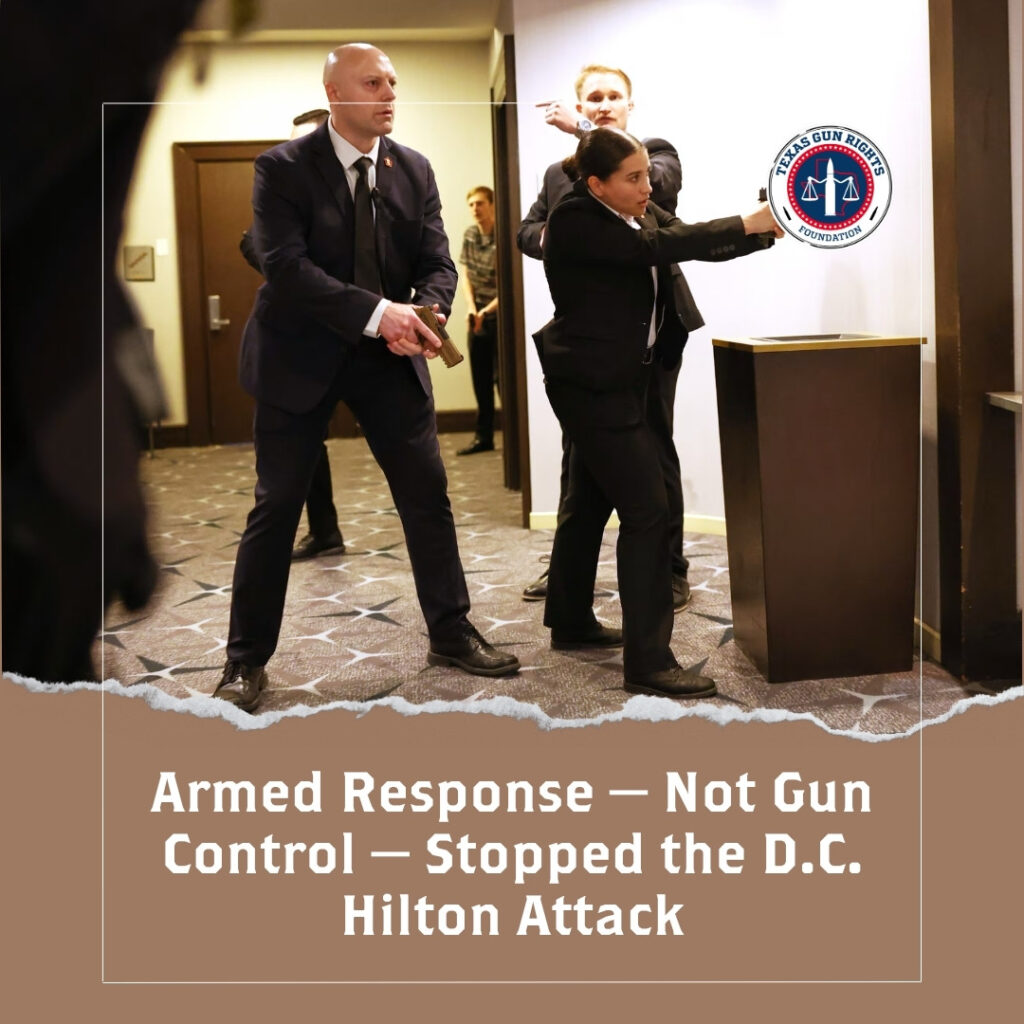
What ultimately stopped the threat was not a regulation or a policy. It was an armed response.
Security personnel and law enforcement officers on site were able to intervene and neutralize the situation before it escalated further.
This outcome aligns with a large body of research showing that the presence of armed defenders significantly reduces both the duration and severity of violent incidents. When resistance is immediate, attackers are far more likely to be stopped before causing widespread harm.
This distinction matters.
Policies that focus exclusively on restricting access to firearms among law-abiding citizens do not directly address those who are already willing to break the law.
What the Data Has Shown for Years
The Washington Hilton incident is not an anomaly. It fits a pattern that has been observed repeatedly.
Research on defensive gun use has consistently found that firearms are used far more often to stop crime than to commit it.
While estimates vary, even conservative analyses show that defensive uses occur on a large scale each year.
More importantly, when victims or responders are armed, violent encounters tend to end more quickly and with fewer casualties.
This is because attackers rarely plan for resistance. Their advantage depends on surprise and the absence of forceful opposition.
When that assumption is disrupted, their ability to carry out the attack collapses.
The outcome in Washington, D.C. followed that exact pattern.
Why This Matters for Texas
The policy implications are especially relevant for states like Texas, which have taken a different approach.
Rather than focusing on restricting access, Texas has increasingly emphasized the role of lawful self-defense.
Constitutional Carry, along with strong legal protections for justified use of force, reflects an understanding that public safety depends not just on prevention, but on the ability to respond when prevention fails.
Texas Gun Rights has played a central role in advancing that framework. By pushing policies that expand the ability of law-abiding citizens to defend themselves, the organization has helped shift the conversation away from restriction and toward capability.
This approach recognizes a fundamental reality: laws cannot guarantee prevention, but they can influence whether people are able to respond when it matters most.
The Broader Lesson
The Washington Hilton attack underscores a point that is often overlooked in policy debates.
Violent acts are not always preventable. Individuals intent on committing them frequently ignore the law altogether.
In those moments, outcomes are determined not by regulations on paper, but by the presence or absence of immediate resistance.
In Washington, D.C., the laws in place did not stop the attack. An armed response did.
That distinction is critical. Public policy should reflect it.
Because when prevention fails — as it sometimes will — the ability to respond is what ultimately determines whether a threat is contained or becomes a tragedy.
Chip in today to help Texas Gun Rights replace failed gun control with policies that actually save lives.