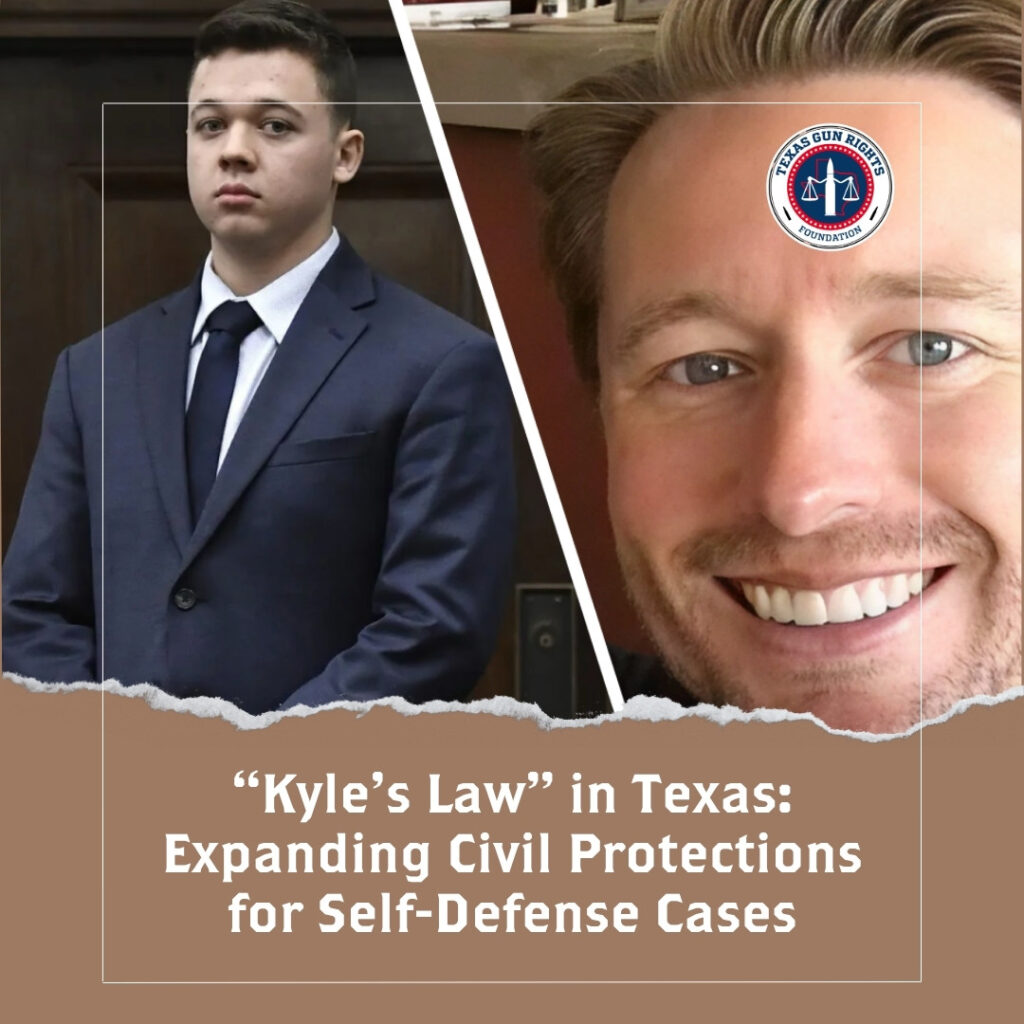
During the 89th Texas Legislative Session, lawmakers considered House Bill 170, commonly referred to as “Kyle’s Law,” a proposal aimed at expanding civil liability protections for individuals who act in self-defense.
The bill passed the Texas House with broad bipartisan support but did not reach final passage before legislative deadlines expired.
Importantly, Texas law already provides civil immunity for justified self-defense. However, HB 170 was designed to address how that protection functions in practice.
Current Texas Law: Civil Immunity Exists, But With Limits
Under Texas Civil Practice and Remedies Code § 83.001, individuals who use force or deadly force that is justified under Penal Code Chapter 9 are generally immune from civil liability.
While this statutory protection is significant, its application can be more limited in practice. Individuals may still be sued and required to defend their actions in court.
There is no automatic presumption of justification based on the outcome of a criminal case, and defendants are not guaranteed recovery of legal expenses.
As a result, even when conduct is ultimately determined to be lawful, the process of litigation itself can impose substantial costs.
Research shows that defending a civil case through trial can cost tens of thousands of dollars, and in some cases far more, depending on complexity.
What Kyle’s Law Would Change
HB 170 sought to strengthen existing protections by modifying how civil courts treat cases involving self-defense. The bill included three key changes:
Presumption of Justification
The bill would create a presumption that a defendant acted lawfully if a grand jury declines to indict, criminal charges are dismissed, or the defendant is acquitted.
This provision would reduce the need for defendants to re-litigate justification in civil court.
Recovery of Legal Costs
The bill would allow individuals found immune from liability to recover attorney’s fees, court costs, lost income, and other related expenses.Economic research suggests that fee-shifting provisions can reduce low-probability lawsuits by increasing the financial risk to plaintiffs.
Alignment of Civil and Criminal Outcomes
By combining a presumption of justification with fee recovery, HB 170 would more closely align civil liability outcomes with criminal determinations and reduce duplicative litigation.
Case Study: Kyle Carruth
In Texas, “Kyle’s Law” is named after Kyle Carruth, a Texas resident whose case highlights the issue the bill seeks to address.In 2021, Carruth was involved in a fatal shooting during a confrontation on his property.
A grand jury declined to indict him after reviewing the evidence.
Despite the absence of criminal charges, Carruth faced civil litigation that lasted for years.
Public reports indicate he incurred approximately $500,000 in legal expenses, ultimately losing his businesses and financial stability before the case was resolved.
From a policy perspective, Carruth’s case illustrates how criminal clearance does not necessarily end legal exposure, and how civil litigation can impose substantial economic costs independent of criminal findings.
A National Comparison: Kyle Rittenhouse
Although outside Texas jurisdiction, the Kyle Rittenhouse case has been cited in similar policy discussions across the country.Rittenhouse was acquitted of all criminal charges related to a 2020 self-defense incident in Wisconsin.
However, civil lawsuits are ongoing, totaling $20 million.
Rittenhouse is currently employed by the Texas Gun Rights Foundation, which was previously invested in his legal battle.
Data on Defensive Gun Use and Legal Exposure
Estimates of defensive gun use vary, but research indicates such incidents occur regularly in the United States.
The National Crime Victimization Survey estimates approximately 60,000 to 100,000 defensive gun uses annually. Other academic estimates suggest higher figures, though methodologies differ.
While only a small fraction of these cases result in fatalities or litigation, those that do often involve both criminal investigation and potential civil liability.
Legal scholars have noted that this dual-track system, criminal and civil, can lead to prolonged legal exposure even when criminal liability is not established.
Legislative Outcome and Future Implications
HB 170 passed the Texas House by a wide margin, reflecting bipartisan support for addressing civil liability concerns in self-defense cases.
However, the bill did not advance through the full legislative process before deadlines expired, leaving current law unchanged.
The policy question remains unresolved: whether civil liability protections in self-defense cases should more closely track criminal outcomes, or whether civil courts should continue to independently evaluate such claims.
As similar cases arise, the issue is likely to return in future legislative sessions.