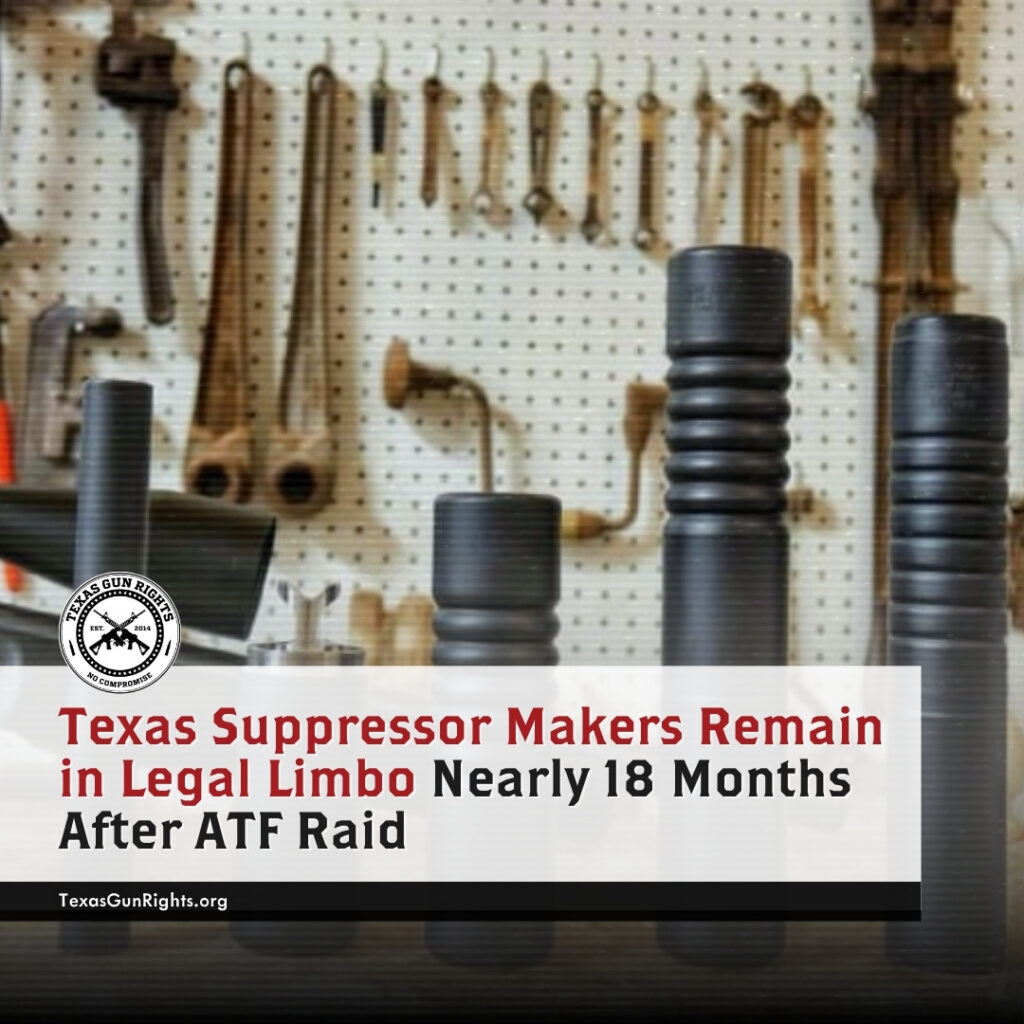
The company, 1836, LLC, owned by Texas Gun Rights members David Abt and Jared Gee, manufactured and sold firearm suppressors pursuant to Texas House Bill 957 — a 2021 state law asserting that suppressors made and retained within Texas are not subject to federal regulation.
According to those involved, agents seized suppressors, display firearms, inventory, and electronic devices.
In the months that followed, authorities reportedly executed additional search warrants at the owners’ businesses and homes, seized firearms and phones, and revoked a federal firearms license associated with a separate entity.
Nearly eighteen months later, Abt and Gee still have no indictment, no returned property, and no resolution.
Now, a key federal deadline has come and gone.
A Constitutional Conflict
At the center of the dispute is a fundamental question: does the federal government have authority to regulate suppressors manufactured and kept entirely within Texas?
Texas H.B. 957 declares such suppressors are not subject to federal registration under the National Firearms Act (NFA).
Federal authorities maintain that suppressors fall under longstanding federal regulation based on Congress’s authority over interstate commerce.
The clash reflects a broader tension between state sovereignty claims and federal firearms law — a conflict that has resurfaced repeatedly in recent years.
Suppressors and the Post-Bruen Legal Landscape
The 1836, LLC dispute is unfolding amid broader litigation over suppressor regulation nationwide.
In Silencer Shop Foundation v. ATF, plaintiffs have questioned whether the federal government can continue enforcing NFA registration requirements after Congress eliminated the NFA tax on certain items.
Removing the tax component strips away the traditional revenue-based justification for the regulatory scheme and raises renewed constitutional scrutiny over what remains.
In the past, courts often upheld federal firearms regulations under intermediate scrutiny standards.
However, the Supreme Court’s decision in New York State Rifle & Pistol Association v. Bruen now requires courts to evaluate firearm laws under a historical-tradition test.
Under that framework, modern regulations lacking historical analogues face greater constitutional uncertainty.
As a result, the legal landscape surrounding suppressor regulation is evolving — and far from settled.
The outcome of these broader cases could significantly shape how disputes like 1836, LLC are resolved.
Forfeiture Proceedings — And a Missed Deadline
Administrative forfeiture proceedings reportedly began in October 2025.
1836, LLC filed a formal claim that same month, triggering a 90-day statutory deadline for the Department of Justice to either initiate judicial forfeiture proceedings or return the seized property.
That deadline expired on February 18, 2026 and the DOJ has neither initiated judicial forfeiture nor returned the property.
Under federal forfeiture law, when the government misses the 90-day deadline, it is generally required to return the property unless it can justify the delay in court.
1836, LLC has indicated it will now pursue litigation to compel the return of its inventory and equipment.
The lapse raises new questions about how the case is being handled — and whether federal authorities intend to prosecute, retreat, or continue delaying resolution.
Criminal Exposure Without Indictment
Although no indictment has been filed, potential federal felony charges remain legally possible.
Many firearms-related offenses carry a statute of limitations of up to five years, meaning charges could theoretically be brought into 2029.
For Abt and Gee, that means years of potential felony exposure without formal charges — a circumstance critics argue functions as punishment by prolonged uncertainty.
Texas Gun Rights President Chris McNutt criticized the situation:
“This is exactly what a weaponized DOJ looks like,” McNutt said.
“You raid small business owners, seize their property, threaten them with federal prison, and then drag it out for years without resolution. These men were operating under Texas law. If the federal government can destroy your livelihood and leave criminal charges hanging over your head for five years without even filing an indictment, that’s not justice — that’s intimidation.”
A Test for the Current Administration
The raid occurred during a period of aggressive ATF enforcement under the Biden administration, including controversial regulatory actions involving pistol braces, forced reset triggers, and expanded firearm definitions.
Now, with a new administration in place, the handling of this missed forfeiture deadline presents a decision point.
Federal officials could continue defending an enforcement action born in a prior regulatory era — or they could return the seized property and clarify enforcement boundaries in a manner consistent with evolving constitutional standards.
Some observers argue this case presents an opportunity for the Department of Justice to demonstrate renewed respect for constitutional limits and cooperative federalism rather than prolonging a standoff that may ultimately require judicial resolution.
What Comes Next
As of now:
- Property remains seized.
- The statutory forfeiture deadline has passed.
- Litigation to compel return of property appears imminent.
- Criminal charges remain legally possible.
At stake is more than one company’s inventory.
Whether this matter ends in quiet correction or escalates into a broader constitutional confrontation now depends on what the Department of Justice does next.
Chip in to Texas Gun Rights to help continue holding federal agencies accountable.