It is about whether a state agency can stretch the law to disarm a man who was never found to be a threat.
The Texas Department of Public Safety (DPS) revoked Timothy Willis’ License to Carry over a 25-year-old Georgia divorce protective order.
That order contained no finding that Willis represented a credible threat to anyone’s physical safety. It did not prohibit the use, attempted use, or threatened use of force. It did not include findings of violence.
It simply required two divorcing spouses to stay away from one another.
That distinction matters — because the law requires it to matter.
What the Law Actually Says
Under federal statute (18 U.S.C. § 922(g)(8)), firearm prohibitions tied to protective orders are not automatic. Congress required specific findings before a person could be disarmed:
A court must determine that the individual represents a credible threat to an intimate partner or child, or
The order must explicitly prohibit the use, attempted use, or threatened use of physical force.
The Georgia order involving Timothy Willis did neither.
Two Texas courts have now confirmed that fact.
Yet DPS treated the order as if it satisfied those requirements anyway.
Two Courts Said No
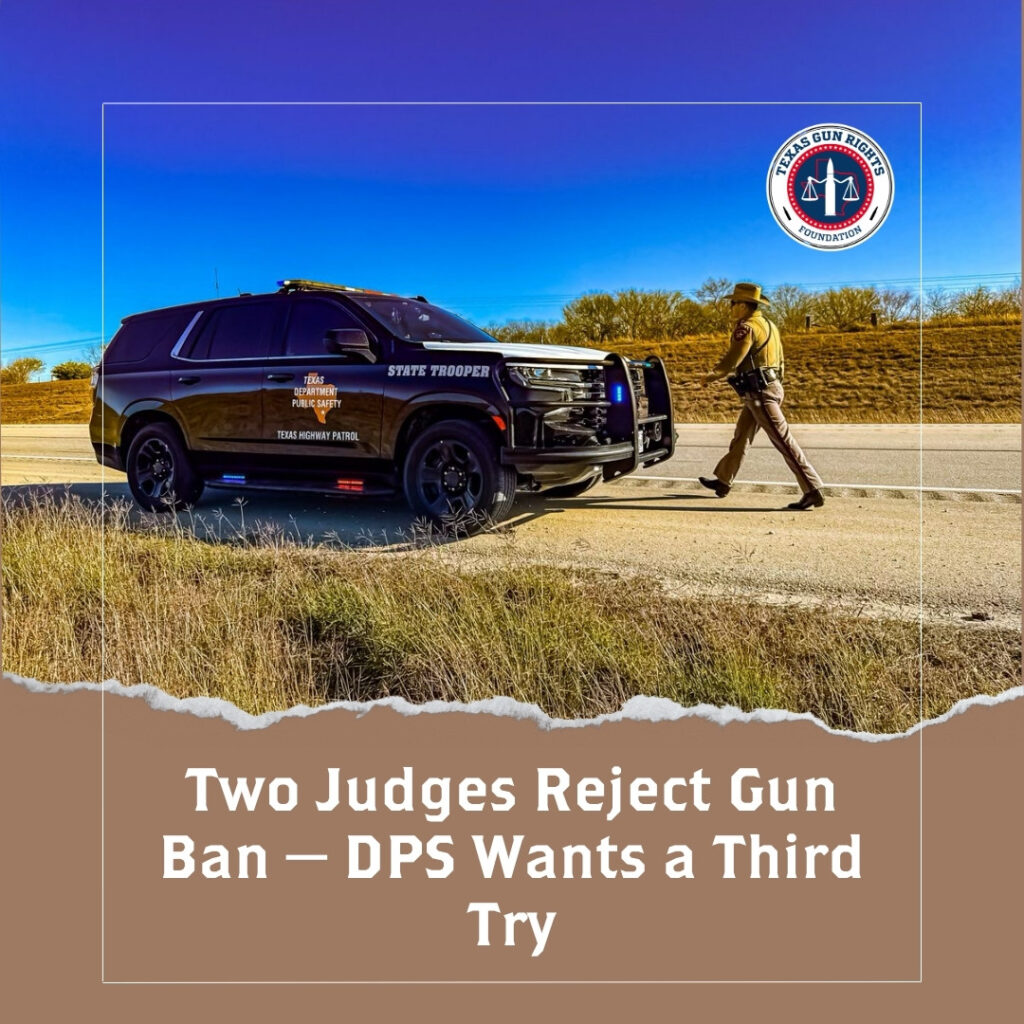
A Justice of the Peace court overturned the revocation. DPS appealed. The case was tried again in county court.
DPS lost again.
Two courts. Two judges. Two rulings confirming that Timothy Willis is not a prohibited person under the law.
Instead of accepting those decisions, DPS has now filed for a retrial — seeking a third opportunity to achieve the same revocation.
At some point, this ceases to be a good-faith disagreement over statutory interpretation.
It begins to look like persistence in pursuit of expanded regulatory power.
When Bureaucratic Interpretation Replaces Statutory Limits
Protective orders in divorce proceedings are often routine. Courts frequently enter mutual “stay away” provisions without evidentiary findings of violence. They are civil procedural tools — not criminal convictions.
If those routine orders can be retroactively transformed into firearm prohibitions decades later — without the findings Congress required — then statutory safeguards become meaningless.
The statute requires findings.
DPS is attempting to substitute assumption.
That is administrative overreach: expanding the reach of a prohibition beyond what lawmakers authorized.
Our constitutional structure is designed to prevent precisely this. Legislatures write laws. Courts interpret them. Executive agencies enforce them.
They do not revise statutory standards when they find them inconvenient.
Why This Matters Beyond One Man
Timothy Willis lived peacefully for more than two decades after his divorce. There was no criminal conviction. No finding of violence. No determination of dangerousness.
If a 25-year-old civil order without required findings can be converted into grounds for revocation, then the implications extend far beyond this case.
It would mean:
Civil paperwork can be reclassified as disqualifying conduct.
Individuals can lose rights without the findings Congress mandated.
Agencies can expand prohibitions through interpretation rather than legislation.
That is not how the rule of law is supposed to function.
When administrative discretion replaces statutory limits, constitutional rights become vulnerable to shifting interpretations rather than fixed legal standards.
Texas Gun Rights Draws a Line
The Texas Gun Rights Foundation, represented by attorney CJ Grisham, has defended Timothy Willis at every stage — and prevailed at every stage.
Now, as DPS seeks yet another attempt to reverse those rulings, Texas Gun Rights has pledged to continue defending him — all the way to the Supreme Court if necessary.
That commitment reflects a larger principle.
This case is not merely about one License to Carry. It is about whether clear statutory requirements will be honored — or whether agencies may stretch them beyond recognition.
Courts exist to enforce the law as written.
Two courts already have.
If higher courts must now speak to clarify the limits of executive authority, the question before them will be straightforward:
Do statutory safeguards mean what they say?
Texas Gun Rights has made clear that it believes they do — and that it will continue defending Timothy Willis until that principle is firmly upheld.