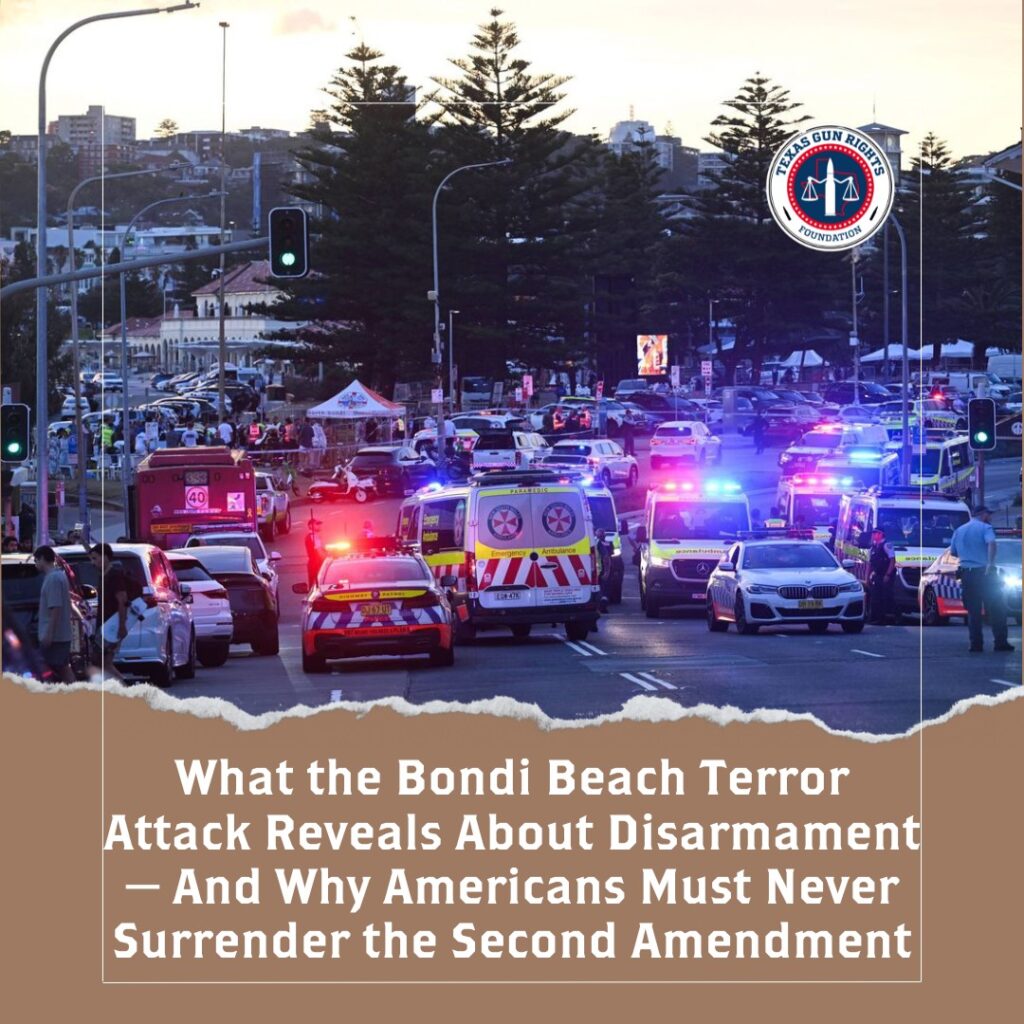
At Archer Park beside Bondi Beach, two men opened fire on families celebrating the first night of Hanukkah — a peaceful Jewish event where children played, elders laughed, and friends gathered in fellowship.
By the time it was over, 16 innocent people lay dead and 40 + wounded, victims ranging from a 10-year-old child to elders in their eighties.
This wasn’t a random crime spree. Australian authorities have treated it as a terrorist attack, driven by Islamic State–inspired extremism — supported by the discovery of homemade ISIS flags and evidence that the assailants were motivated by radical ideology.
And here is the stark, uncomfortable truth that must not be sugar-coated: Australia disarmed its population.
After the 1996 Port Arthur massacre, Canberra enacted some of the strictest firearm laws in the Western world, effectively banning civilian access to most semi-automatic firearms and instituting stringent licensing requirements.
Yet on this day — despite those strict laws — a terror attack unfolded with no effective opportunity for the citizens under fire to defend themselves. The weapons used were legally owned by the older attacker, licensed under Australia’s regulatory system.
And while officials in Canberra now vow to tighten gun laws even further — proposing limits on licenses, tighter vetting, and a national firearm registry — one must ask: to what end? The killers already moved within the system. They already legally possessed long guns. And when faced with slaughter in a crowded public space, the people at Bondi Beach did not have the ability to return fire.
There was one exception: a brave bystander, Ahmed al-Ahmed, a 43-year-old Sydney man who risked and sustained injuries tackling one of the shooters and wresting away a rifle. His heroism undoubtedly saved lives. But he was unarmed at the start. He had nothing more than hands and courage to stand against rifles firing into a crowd.
Imagine, for a moment, if that crowd had included law-abiding adults with the means to defend themselves. Imagine if an attacker had to think twice before opening fire into a sea of armed and determined defenders — not guaranteed deterrence, but a fighting chance for innocent lives.
In Australia, they chose total civilian disarmament. In Sydney, dozens paid the price in blood. And now there are calls for even stronger restrictions on firearms ownership. That is a predictable response — but it is also a dangerously incomplete one.
Because this was not a crime of passion, workplace grievance, or family dispute. This was Islamist terror, a deliberate massacre of Jews — on a Jewish holiday — with documented ties to extremist ideology that has sparked violence across the globe.
And yet, rather than questioning the logic of a defenseless society, leaders react by doubling down on disarmament.
Here in the United States, the debate over the Second Amendment is painted by our opponents as one between “safety” and “reckless gun ownership.” But what happened at Bondi Beach is proof positive that the enemy of safety is helplessness under attack.
America’s founding fathers — steeped in the hard lessons of tyrants, invaders, and terror — enshrined the right of the people to keep and bear arms not as a quaint concession, not as a sporting privilege, but as a bulwark against tyranny and terror alike. We guard that right not because guns are sacred; we guard it because self-defense, deterrence, and the ability to answer violence with resistance are the last refuge of life and liberty.
What happened on Bondi Beach should sober every freedom-loving citizen: Disarmament invites vulnerability. Criminals and terrorists will always find ways to arm themselves — whether through illegal markets, improvised weapons, or radicalized determination.