Washington just blinked.
In a major development out of the ongoing Texas v. ATF lawsuit, the Department of Justice has dropped its defense of the ATF’s “engaged in the business” rule — a sweeping Biden-era policy designed to crack down on private gun sales and expand federal control over law-abiding gun owners.
For months, gun owners were told this rule was inevitable.
Now, the federal government is backing away from defending it in court.
What the Rule Was Really About
The ATF’s “engaged in the business” rule was never about criminals.
It was about redefining who qualifies as a gun dealer, pulling more private individuals into a federal registry by forcing them to obtain licenses and run “background checks.”
And it didn’t come out of nowhere.
This rule was made possible by the Bipartisan Safer Communities Act (BSCA) of 2022, the same bill pushed through Congress by Senator John Cornyn, who worked hand-in-hand with Democrats to expand federal authority over gun sales.
Without Cornyn’s bill, the ATF wouldn’t have had the leverage to push this rule in the first place.
Texas Gun Rights warned Cornyn exactly what would happen.
He ignored those warnings, and when the ATF did exactly what was predicted, he issued a public statement to try and save face, but never took legislative action to repeal his blunder.
Texas Fights Back And Wins Ground
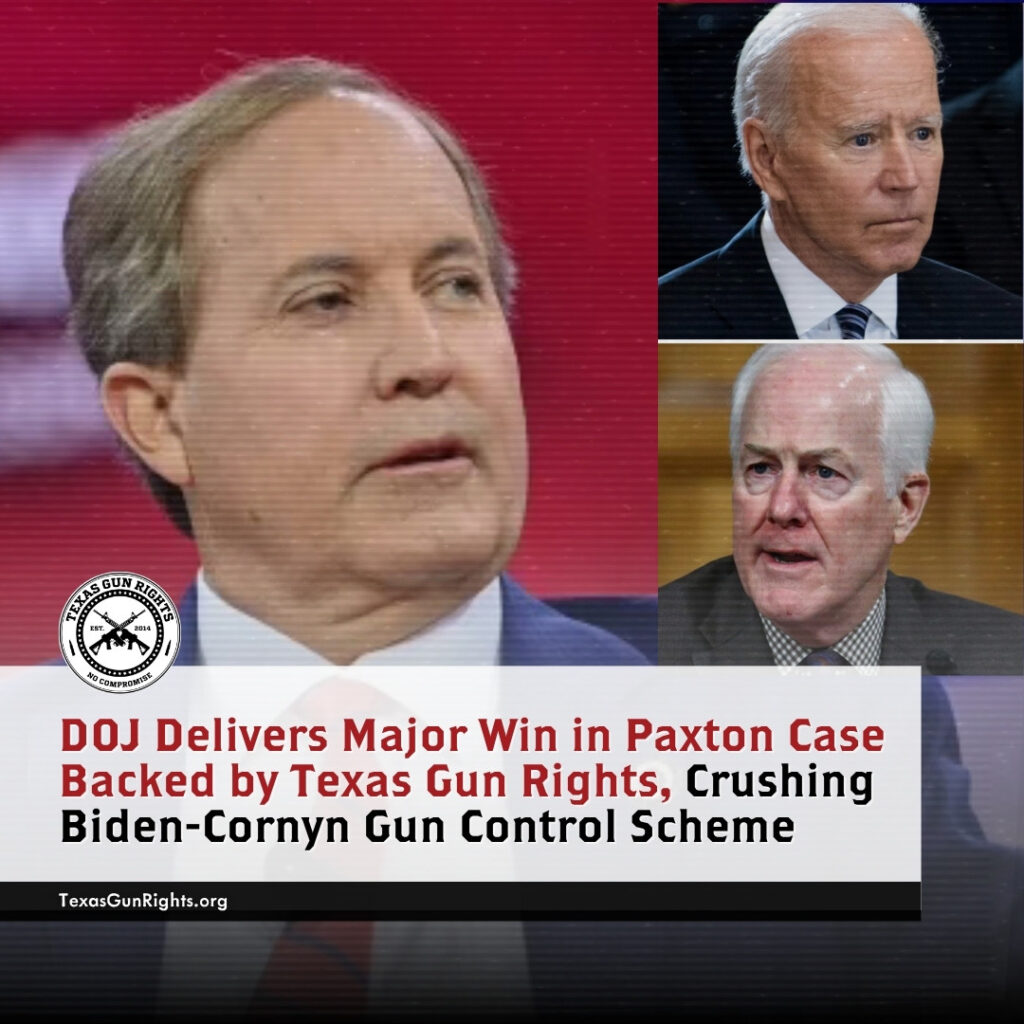
Texas Attorney General Ken Paxton filed suit to stop the rule, arguing it exceeded federal authority and targeted law-abiding citizens.
Now, with DOJ backing off its defense, that challenge is paying off.
A preliminary injunction is already in place, blocking enforcement of the rule in Texas for covered parties while the courts consider a final ruling.
“This is exactly what happens when the federal government’s gun control schemes are dragged into the light,” said Chris McNutt, President of Texas Gun Rights.
“They collapse. This rule was never about public safety, it was about building a system to monitor and control lawful gun owners. And now the DOJ knows it can’t defend it.”
This isn’t the end of the fight, but it’s a clear sign the rule is on shaky legal footing.
Texas Gun Rights Was in the Fight Early
Texas Gun Rights didn’t wait for the outcome.
Back in late 2024, TXGR joined the legal battle by filing an amicus brief supporting the challenge, pushing the courts to recognize the broader constitutional implications of ATF overreach.
That filing focused on a critical issue:
When federal agencies impose nationwide rules that violate the Constitution, courts must have the authority to stop them — not just for a few plaintiffs, but for all Americans.
That legal strategy is now colliding directly with reality.
And the DOJ’s retreat is one of the first signs of that pressure working.
What Happens Next — And What It Means for Gun Owners
The DOJ backing down does not automatically kill the rule.
But it puts the ATF in a corner.
Right now, a federal injunction is already blocking this rule in Texas, protecting many gun owners while the case moves forward.
And now, with the federal government no longer willing to defend it, the path forward becomes much clearer:
- The court can move toward a ruling without a real defense from DOJ
- Judges have stronger grounds to expand the existing injunction
- A nationwide injunction or full vacatur is now firmly on the table
- The ATF may be forced to quietly withdraw or rewrite the rule altogether
In plain terms:
This rule is no longer on solid ground.
It’s on borrowed time.
And if the courts follow through, it could be struck down entirely — not just in Texas, but across the country.
For gun owners, that proves something critical:
These federal gun control schemes are not untouchable.
They can be challenged.
They can be weakened.
And they can be defeated.
But only if someone is willing to fight in the courts, in elections, and in the halls of Congress.
And it sends another message just as clearly:
Politicians who enable the gun confiscation agenda don’t get a pass just because they have an “R” next to their name.
“This is a warning shot,” McNutt added. “Any politician, Republican or Democrat, who helps advance the gun confiscation agenda should expect to be exposed, challenged, and held accountable.”
Political Fallout: Cornyn vs. Paxton
This fight isn’t happening in a vacuum.
It’s unfolding in the middle of a high-stakes U.S. Senate runoff between Ken Paxton and John Cornyn.
On one side, Paxton is leading the lawsuit to stop federal overreach.
On the other side is Cornyn, whose legislation made the rule possible.
That contrast couldn’t be clearer.
One is fighting to stop the policy.
The other helped create it.
Texas Gun Rights is committed to exposing and holding accountable ANY politician who betrays the Second Amendment — and taking that same no-compromise fight into the courtroom — chip in now to help fuel the fight.