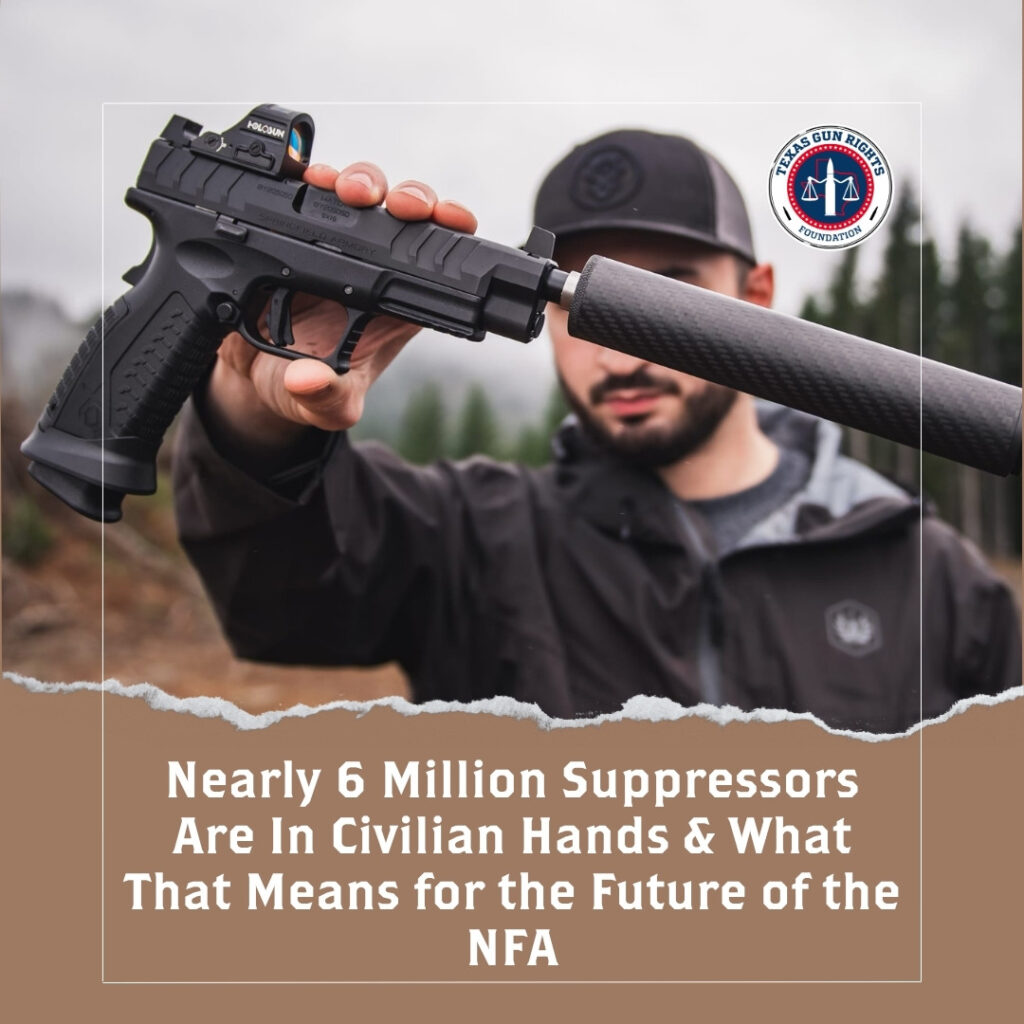
The number of legally registered firearm suppressors in the United States is now approaching 5.7 million, according to the latest federal data obtained by the American Suppressor Association.
That figure represents a dramatic increase over the past decade, and it raises a fundamental legal question:
At what point does a heavily regulated item become so widely owned that the law restricting it can no longer stand?
For suppressors, that point may already have been reached.
What Suppressors Are… And Why That Matters Legally
A suppressor, often inaccurately referred to as a “silencer,” is a simple mechanical device attached to the end of a firearm’s barrel.
Its purpose is to reduce the noise and concussion produced when a firearm is discharged.
Contrary to popular portrayals, suppressors do not render firearms silent.
Even with a suppressor, gunfire remains loud — often comparable to heavy machinery.
What suppressors do is reduce peak sound levels to safer ranges.
In practical terms, they function as hearing protection.
Unlike the types of weapons historically subject to strict regulation, suppressors do not increase a firearm’s lethality, rate of fire, or concealability.
They do not change how a firearm operates.
They simply reduce noise.
Regulated Like Machine Guns, Despite Being Safety Devices
Despite their limited function, suppressors remain regulated under the National Firearms Act of 1934 (NFA) — the same legal framework used to regulate machine guns.
To legally acquire one, Americans must submit to a federal background check, register the device with the federal government, and often wait months for approval.
This framework was created in an era shaped by Prohibition-era crime and early 20th-century fears about criminal misuse of certain weapons.
Suppressors were swept into that system without a clear historical tradition of regulation, and without evidence that they posed a comparable threat.
The “Common Use” Problem for the NFA
Modern Supreme Court precedent has introduced a critical standard:
Arms that are “in common use” for lawful purposes are protected by the Second Amendment.
With nearly 6 million suppressors in civilian hands, the classification of suppressors as restricted items becomes increasingly difficult to defend.
These are not rare or unusual devices: they are owned by millions of Americans, used overwhelmingly for lawful purposes, and their primary function is safety.
As Chris McNutt, President of Texas Gun Rights, put it:
“When millions of Americans are legally purchasing and using suppressors for lawful purposes, it becomes impossible to argue they are ‘unusual’ or outside the scope of the Second Amendment,” McNutt said.
“The federal government is treating a safety device like a machine gun, and that simply doesn’t hold up under constitutional scrutiny.”
That reality creates a direct tension between modern constitutional doctrine and federal law.
A Growing Disconnect Between Law and Reality
The continued inclusion of suppressors under the NFA reflects a broader problem.
The law has not kept pace with usage.
Machine guns are capable of sustained automatic fire which is why they (incorrectly) received such heavy scrutiny.
Suppressors do none of that. They do not enhance offensive capability. They mitigate side effects.
Yet both remain grouped together under the same regulatory structure.
Under the Supreme Court’s decision in New York State Rifle & Pistol Association v. Bruen, the government must justify modern firearm regulations by pointing to historical analogues.
There is little evidence of any historical tradition of regulating noise-reduction devices.
That leaves suppressor regulation in an increasingly vulnerable legal position.
What Comes Next for the NFA
The rapid growth in suppressor ownership is not just a market trend, it is a constitutional stress test.
Every additional lawful owner strengthens the argument that suppressors are in common use.
Every approval issued undercuts the claim that they are inherently dangerous or unusual.
And every year the number grows, the gap between the law and reality widens.
This is not a theoretical debate. It is already being tested in the courts.
The Texas Gun Rights Foundation is actively monitoring litigation challenging federal suppressor regulations, including SilencerCo v. ATF, one of the leading cases directly confronting the constitutionality of NFA restrictions on suppressors.
That case squarely presents the question of whether the federal government can continue to regulate a widely owned safety device under a framework designed for fundamentally different weapons.
If courts apply the “common use” test consistently, suppressors present one of the clearest examples of a commonly owned, lawful item being subjected to extraordinary federal regulation without historical justification.
That is not a marginal issue.
It goes to the core of whether the NFA can continue to withstand constitutional scrutiny in its current form.
At some point, courts will be forced to reconcile that contradiction.
And when they do, the question will not be whether suppressors are commonly owned.
It will be whether the federal government can continue to regulate them as if they are not.