
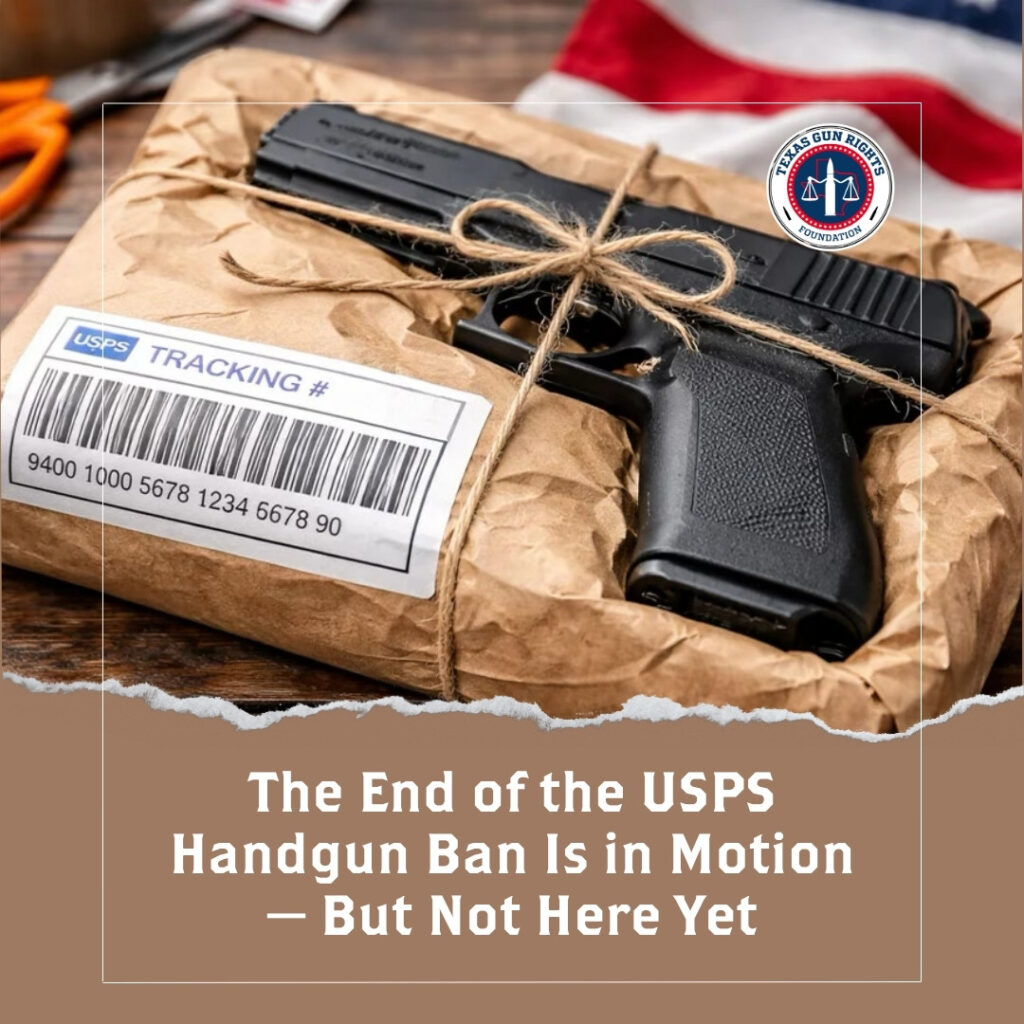
For nearly a century, federal law has prohibited ordinary Americans from mailing handguns through the U.S. Postal Service.
That restriction, rooted in a 1927 statute, is now on the verge of collapse.
But while the legal foundation of the ban has already been undermined, the practical ability for gun owners to mail handguns is still months away.
Understanding that distinction is critical.
Earlier this year, the Department of Justice’s Office of Legal Counsel concluded that the federal ban on mailing handguns is unconstitutional.
The DOJ’s reversal did not occur in a vacuum.
It was prompted by ongoing litigation brought by gun rights advocates challenging the constitutionality of the mailing ban — part of a broader legal effort to force federal agencies to justify longstanding restrictions under modern constitutional scrutiny.
However, the process of unwinding a federal regulation is not instantaneous. The law may be effectively dead in principle, but it remains in place in practice — at least for now.
A Ban From Another Era
The prohibition dates back to 1927, when Congress moved to restrict the mailing of concealable firearms.
Lawmakers at the time were concerned about the spread of handguns through mail-order catalogs, but the historical record shows those concerns were often tied to broader efforts to restrict access among disfavored groups.
Importantly, the ban did not target criminal misuse.
Instead, it targeted the method of lawful acquisition and transport, a distinction that has become increasingly difficult to defend under modern constitutional scrutiny.
Under District of Columbia v. Heller, McDonald v. Chicago, and New York State Rifle & Pistol Association v. Bruen, the Second Amendment protects not only the possession of firearms, but also the ability to acquire and maintain them for lawful purposes.
The DOJ’s conclusion follows directly from that principle: if Americans have a right to keep and bear arms, they must also have practical means to obtain and transport them.
Where Things Stand Now
Despite the DOJ’s opinion, the USPS has not yet finalized changes to its regulations. That process is underway, but it takes time.
In April 2026, the Postal Service published a proposed rule that would allow lawful handgun mailing under regulated conditions.
This triggered the formal federal rulemaking process, including a public comment period and internal review.
That means the current reality is somewhat paradoxical.
The federal government has acknowledged that the ban is unconstitutional.
But until the regulatory process is complete, postal employees are still bound by existing rules.
Practically speaking, gun owners cannot yet walk into a post office and legally mail a handgun, and USPS employees must still enforce the current prohibition.
The change is coming, but it hasn’t been implemented yet.
The Timeline Ahead
Based on the standard federal rulemaking process, the timeline is relatively clear.
Spring 2026: Public comment period and initial review
Late Summer to Fall 2026: Final rule issued by USPS
Late 2026 to Early 2027: Rule takes effect nationwide
This assumes no major delays.
Legal challenges, political pressure, or additional revisions could push the timeline further.
But barring those complications, the handgun mailing ban is unlikely to survive beyond the next year in any meaningful form.
Why This Matters
At first glance, the ability to mail a handgun might seem like a narrow issue. In reality, it has broad implications.
The current ban forces gun owners to rely on private carriers, which often impose higher costs, stricter policies, and logistical hurdles.
In some cases, lawful gun owners face delays or outright refusal of service when attempting to ship firearms for repair, sale, or transfer.
Economically, this operates as a de facto tax on a constitutional right.
Allowing USPS to handle lawful handgun shipments would reduce shipping costs, expand access for rural gun owners — including many in Texas –, simplify repairs, returns, and transfers, and increase competition in firearm-related services.
These are not trivial changes. They affect how easily Americans can exercise a fundamental right.
A Broader Constitutional Shift
The reconsideration of the USPS handgun ban is part of a larger pattern.
Regulations that once went unchallenged are now being reevaluated under the Bruen standard, which requires historical justification for modern firearm restrictions.
Many such regulations, particularly those targeting lawful conduct rather than criminal misuse, are increasingly difficult to defend.
Dudley Brown, President of the National Association for Gun Rights, emphasized this broader trend in recent Senate testimony, arguing that restrictions like the USPS handgun ban reflect a longstanding pattern of regulating lawful behavior instead of addressing criminal misuse.
“For decades, the federal government has imposed restrictions on the exercise of Second Amendment rights that have no basis in history or constitutional text,” Brown testified.
“The ability to acquire and transport firearms is inseparable from the right itself.”
For organizations like the Texas Gun Rights, this development reinforces a key principle:
The Second Amendment is not limited to possession. It protects the practical ability to exercise the right, including acquisition, transport, and use.
“For decades, the federal government has treated the Second Amendment like a second-class right: regulating not just misuse, but the everyday, lawful exercise of it,” said Chris McNutt, President of Texas Gun Rights.
“This opinion confirms what we’ve said all along: the government doesn’t get to block access to firearms by restricting how law-abiding Americans buy, sell, or transport them. The Constitution protects the right in full, not just what’s convenient for bureaucrats to allow.”
What Texas Gun Owners Should Expect
For now, the answer is patience.
Texas gun owners should expect the USPS handgun mailing ban to be formally overturned through the regulatory process, not overnight.
The legal groundwork has already been laid. The remaining steps are procedural.
Once finalized, the change will make firearm ownership more accessible, less costly, and less dependent on private intermediaries.
But until then, existing USPS rules remain in effect.