
For years, gun owners were told the same thing:
“There is no federal gun registry.”
Now, even members of the U.S. Senate are being forced to confront a different reality.
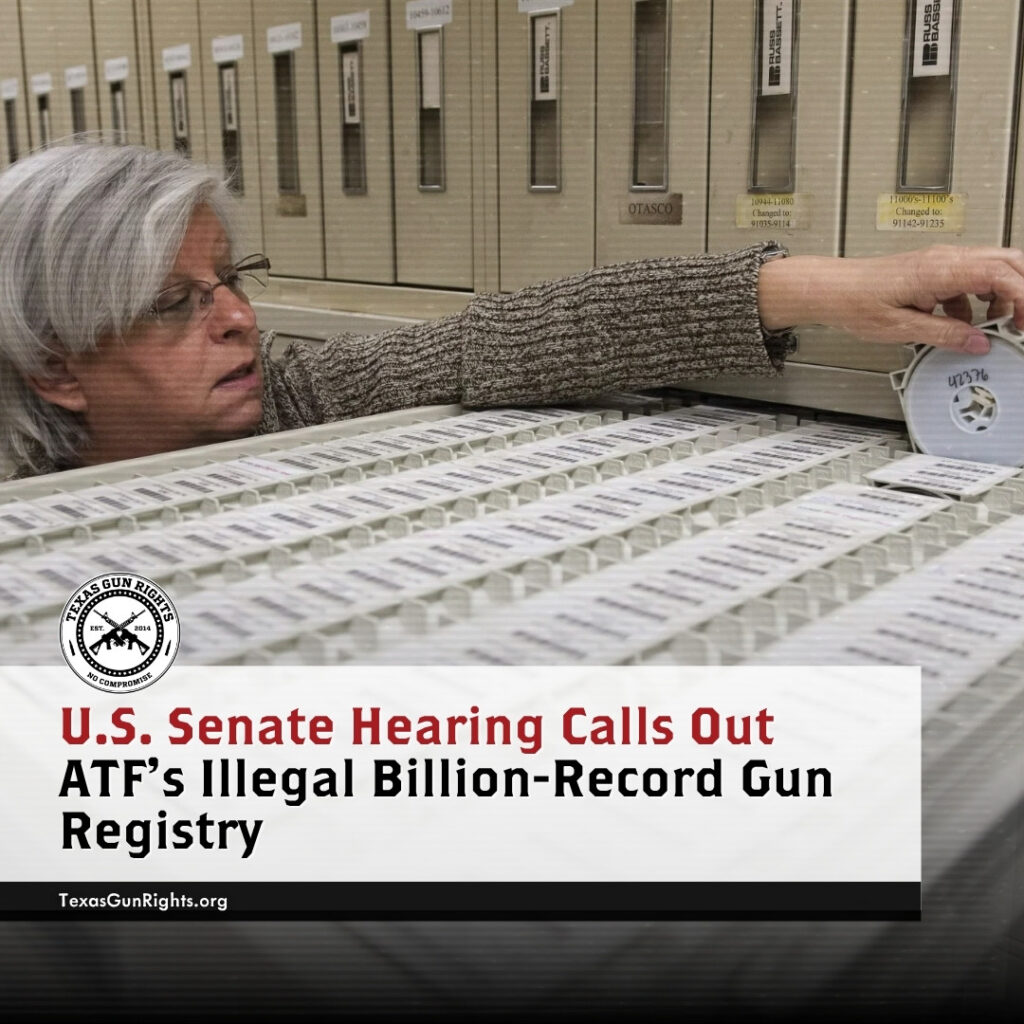
During a recent Senate hearing, lawmakers pressed federal officials over the explosive growth of the ATF’s firearm records database — a system that now contains approaching one billion records tied to gun purchases and gun owners across America.
Call it what you want.
A “tracing system.”
A “records archive.”
A “law enforcement tool.”
But when the federal government is sitting on a centralized, digitized collection of firearm transaction records tied to law-abiding citizens…
Gun owners know exactly what that looks like.
How the ATF Built a Registry Without Calling It One
The ATF didn’t pass a law creating a national gun registry.
They didn’t need to.
Instead, they built it piece by piece.
Gun dealers who go out of business are required to turn over their records including names, addresses, and firearm purchase information.
The ATF has been digitizing and centralizing those records at scale.
At the same time, Biden-era policies forced gun dealers to retain those records indefinitely, accelerating the flow of data into federal hands.
The result is a massive and growing federal database — one that, while not currently searchable by name, contains the raw information needed to track lawful firearm ownership on a national scale.
As the database has expanded, critics argue the distinction between a “tracing system” and a registry is becoming increasingly difficult to maintain.
Erich Pratt, President of Gun Owners of America, made that concern explicit during recent Senate testimony, warning lawmakers that the system is “not a registry in name only” but “a confiscation list waiting to be used.”
A Direct Conflict With Federal Law
This is where things get even more serious.
Federal law, specifically the Firearm Owners’ Protection Act of 1986, explicitly prohibits the creation of a national gun registry.
That prohibition wasn’t accidental.
It was put in place because lawmakers understood exactly what happens when the government knows who owns firearms, what they own, and where they live.
History has shown, time and again, that registration is the first step toward confiscation.
Why This Matters Right Now
The Senate hearing didn’t just expose the size of the database. It exposed something far more significant:
The federal government already possesses the infrastructure necessary to track firearm ownership on a massive scale.
All that remains is access and policy.
A regulatory change, a shift in enforcement priorities, or a future administration willing to expand the system’s use could transform what exists today into something far more expansive and intrusive.
That is not speculation. It is the logical outcome of building and maintaining a centralized repository of this size.
A Broader Threat to Freedom
This issue extends beyond firearms.
At its core, it concerns the relationship between citizens and the federal government.
When the government maintains detailed records on the lawful activities of millions of Americans, it alters that balance, particularly when those records involve the exercise of a constitutional right.
The Second Amendment was not written to facilitate government oversight of firearm ownership. It was written to limit government power.
A centralized database of gun owners moves in the opposite direction.
Why Texas Gun Rights Is Taking a Different Approach
For Texas Gun Rights, this development reinforces a long-standing concern.
Federal agencies do not need explicit authorization to expand their reach when the underlying legal and regulatory framework allows it to happen incrementally.
That is why TXGR has focused not only on opposing new gun registration schemes, but on addressing the root of the problem.
“This is exactly how gun registration has always been built in this country: quietly, bureaucratically, and under the excuse of administration,” said Chris McNutt, President of Texas Gun Rights.
“They don’t call it a registry, but they’re collecting the data, centralizing it, and waiting for the political moment to use it. That’s why we’re not interested in reforming the ATF, we’re working to abolish it.”
From that perspective, the solution is not limited to oversight or incremental reform.
It requires:
Ending the authority of agencies like the ATF to regulate lawful gun ownership.
Repealing federal laws, including the Brady Act & National Firearms Act, that enable ongoing federal control.
Preventing the continued accumulation of firearm ownership data at the federal level.
The Senate hearing has brought increased scrutiny to the ATF’s database, but scrutiny alone does not change policy.
The records remain in federal possession.
The system continues to operate.
And the database continues to grow.
What happens next will depend on whether policymakers move to restrict, dismantle, or expand the system.
Donate to Texas Gun Rights to help stop gun registration schemes, abolish the ATF, and repeal the NFA before bureaucrats turn this database into a weapon against the American people.